Q15 - Ventilation and Respiratory Gas Control
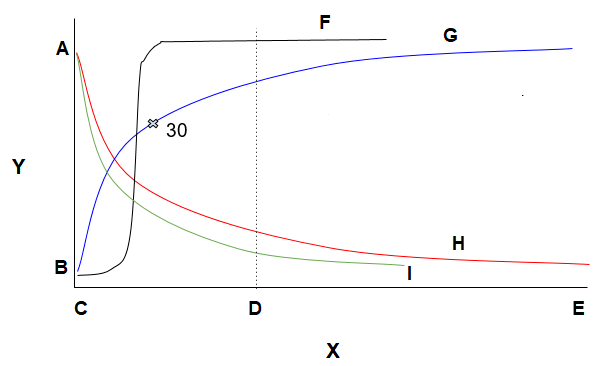
Breathing rate is usually controlled by pH (proportional to carbon dioxide) sensors in the brain. Oxygen sensors, in the major arteries, only influence breathing when the partial pressure of oxygen falls below ~30 mmHg. These sensors stimulate ventilation as oxygen falls below this level.
Figure 1 shows how the partial pressure/amount of respiratory gases change in alveolar air and blood as a function of ventilation rate in normal sea level atmosphere.
True or False?
Q15.1. These curves show evidence that haemoglobin can bind carbon dioxide to form carboxyhaemoglobin.
Q15.2. If the nerves to the oxygen sensors are cut, a person at a very high altitude will breathe more quickly.
Q15.3. These curves show that controlling breathing primarily via CO2 levels, rather than via O2 levels, is an arbitrary accident of evolution, rather than clearly advantageous.
Q15.4. Someone ascending to a very high altitude quickly will suffer decreasing pH in their brain.
Q15.5. The submariners in the previous question (130% sea-level pressure, 16% oxygen) will experience a fall in pH when exposed to their atmosphere.
Question reproduced from IBO 2023, Theoretical Paper 2, licensed under CC BY-NC-SA 4.0 - attributed to the International Biology Olympiad. Open the full exam PDF