Q17 - Glucose Oxidase and Enzyme Kinetics
The Michaelis-Menten equation describes the relationship between substrate concentration ([S]) and enzymatic reaction rate (v).
Km = the Michaelis constant, which is the substrate concentration at which v = ½Vmax and represents the affinity of enzymes to particular substrates.
Vmax = the maximum rate in a given reaction mixture.
Glucose oxidase catalyses the oxidation of glucose (MW 180 g/mol) to glucono-1,5-lactone, while O2 is reduced to H2O2. For glucose oxidase Km is estimated as 25 mmol/l.
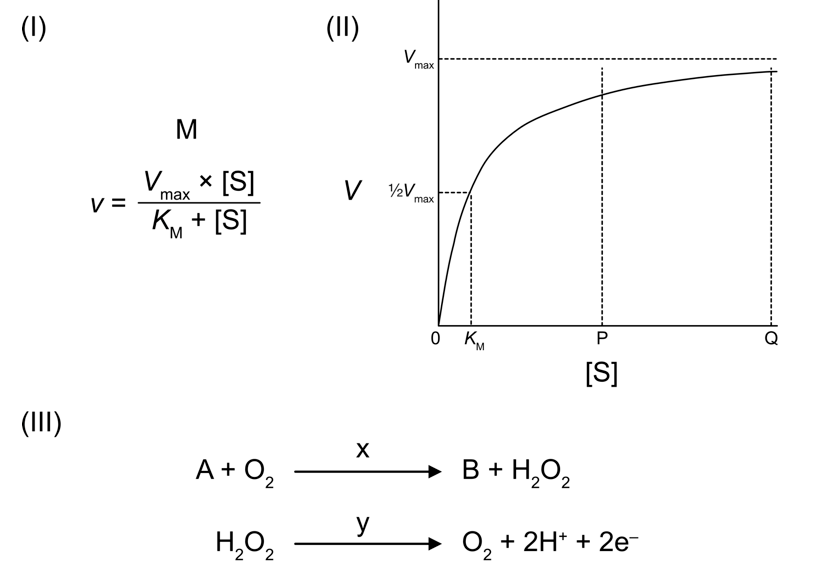
A reaction catalysed by glucose oxidase is used to measure blood glucose concentration. A glucose meter is actually an electric current meter. The blood sample is applied to a strip containing immobilized glucose oxidase, and the meter records the flow of electrons accompanying the oxidation of H2O2 catalysed by a non-enzymatic catalyst contained in the meter strip.
True or False?
Question reproduced from IBO 2023, Theoretical Paper 2, licensed under CC BY-NC-SA 4.0 - attributed to the International Biology Olympiad. Open the full exam PDF