Q32 - Seabird Foraging and Niche Segregation
Seabirds spend much of their lives in the open ocean foraging but, during breeding, they congregate on remote islands or cliffs to nest. Figure A shows the foraging distribution of four species of seabirds. Relative proportions of stable isotopes (15N and 13C) were determined from blood collected from breeding individuals (Figure B).
| Species | Max diving depth (m) |
|---|---|
| Atlantic Puffin (Fratercula arctica) (n=3) | 60 |
| Razorbill (Alca torda) (n=5) | 120 |
| Common Murre (Uria aalge) (n=5) | 180+ |
| Thick-billed Murre (Uria lomvia) (n=7) | 180+ |
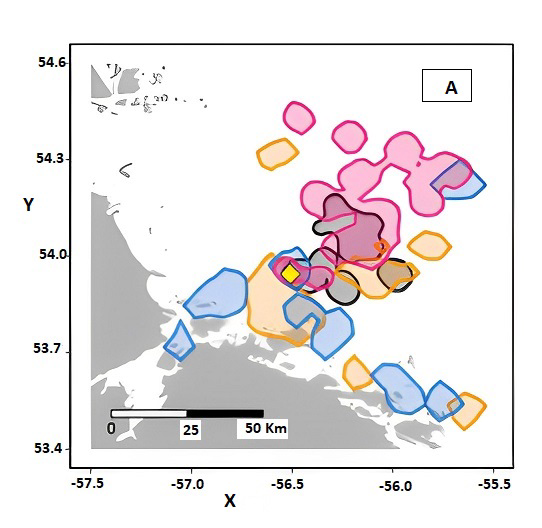
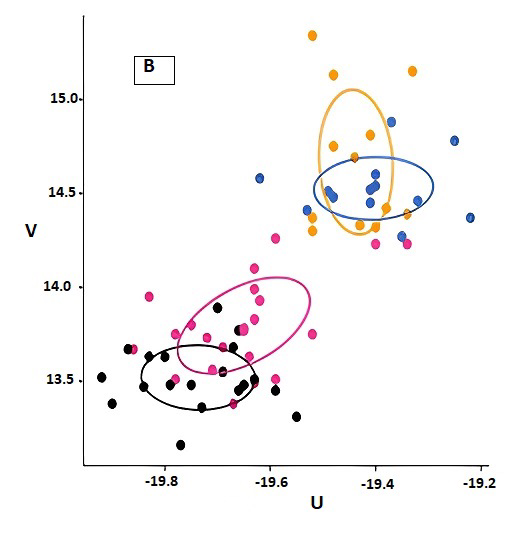
Based on the figures above, state if the following statements are true or false.
Q32.1. The foraging patterns indicate evidence of niche segregation in Atlantic Puffins and Razorbills.
Q32.2. Common Murres and Thick-billed Murres have similar diets.
Q32.3. Atlantic Puffins mostly forage in near-shore areas (close to the coast).
Q32.4. Razorbills and Common Murres have similar diets.
Q32.5. Thick-billed murres and razorbills have considerable foraging overlap.
Question reproduced from IBO 2023, Theoretical Paper 2, licensed under CC BY-NC-SA 4.0 - attributed to the International Biology Olympiad. Open the full exam PDF