Q39 - RNA Editing Mechanisms
RNA editing is the process of RNA sequence modification by different enzymes.
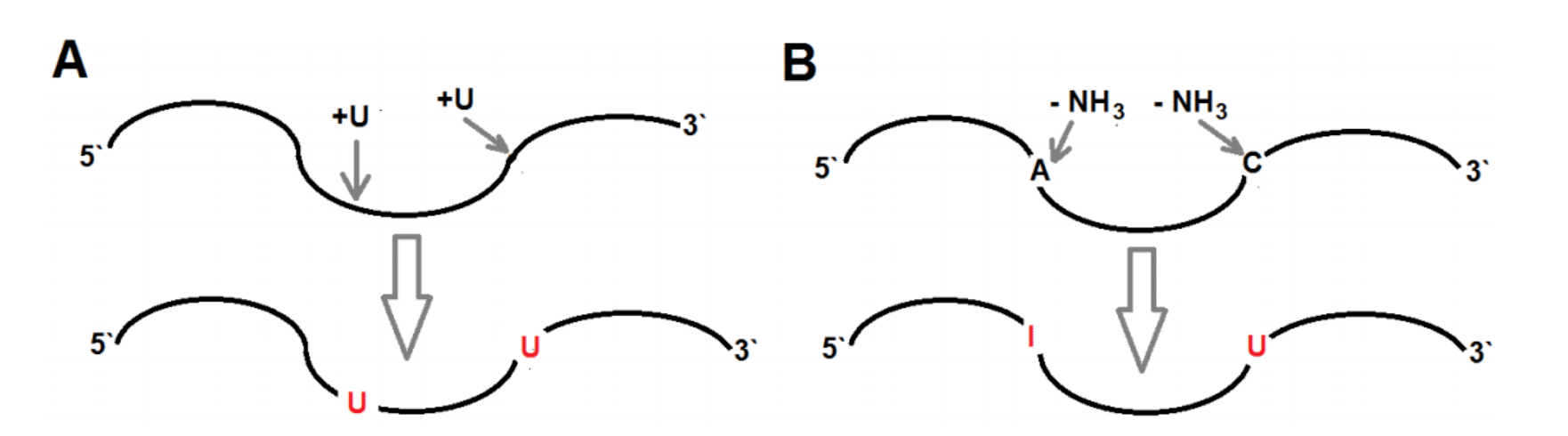
RNA editing was discovered in the Trypanosoma kinetoplast, where a specific mechanism adds several uridine nucleotides into specific mRNA sites using a guide RNA (Figure A).
Another RNA editing mechanism was discovered in mammals: specific APOBEC enzymes deaminate cytosine to uracil, and specific ADAR enzymes deaminate adenine to hypoxanthine (inosine nucleotide) (Figure B).
True or False?
Q39.1. RNA editing processes are highly conserved, with similar mechanisms in all eukaryotes, from trypanosomes to mammals.
Q39.2. RNA editing can shift the reading frame in mRNA.
Q39.3. RNA editing can result in protein isoforms with different molecular weights.
Q39.4. RNA editing occurs only in the nucleus.
Question reproduced from IBO 2023, Theoretical Paper 2, licensed under CC BY-NC-SA 4.0 - attributed to the International Biology Olympiad. Open the full exam PDF