Q41 - RFLP Analysis of Cat Mucolipidosis
Restriction fragment length polymorphism (RFLP) analysis consists of:
- amplification of a DNA fragment by PCR,
- digestion of the PCR product with a restriction enzyme,
- DNA electrophoresis.
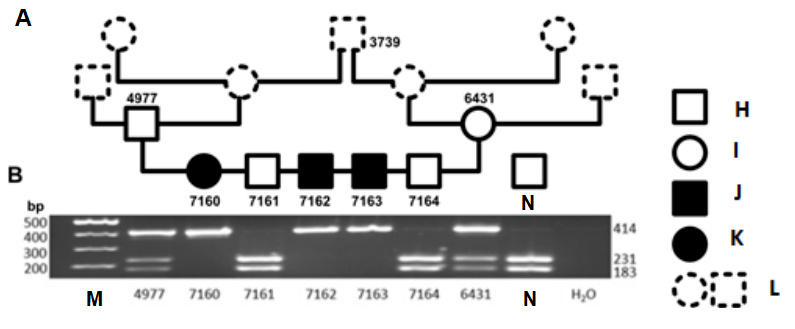
The RFLP method was used to detect the recessive allele of the GNPTAB gene, which causes a genetic disease in cats, mucolipidosis II. A point mutation in the recessive allele changes the sequence of the 882 codon of the gene from CAG to TAG.
The diagram shows the result of analysis of the GNPTAB gene of related cats. A 414 bp fragment of the GNPTAB gene was amplified and digested with the restriction enzyme PstI. PstI recognises and cuts the sequence: 5’-CTGCAG-3'.
Part A presents the family tree with a legend, while part B presents the result of the RFLP analysis. The analysis was also performed using the genetic material of an unrelated healthy cat (designated as “Normal”). There was another sample which contained water during PCR, instead of template DNA (designated as “H₂O”).
True or false?
Question reproduced from IBO 2023, Theoretical Paper 2, licensed under CC BY-NC-SA 4.0 - attributed to the International Biology Olympiad. Open the full exam PDF