Q5 - Angler Fish Immunity and Mating
Genome sequencing has shown that many fish species appear to be partly or completely immunodeficient. Consider the drawings of four Angler fish. Analyze the evidence that they have lost some of the genes that are important for the immune system.
- Aicda is the gene for cytidine deaminase. In B cells, it is required for hypermutation during antibody maturation and class switching.
- Cd3z is the gene for a key T cell receptor signal transduction protein.
- Cd4 is the gene for an MHC II co-receptor of T helper cells.
- Cd8a and Cd8b are the genes of MHC I co-receptors of T killer cells.
- Rag1 is the gene for the enzyme conducting V(D)J recombination (recombination in the genes for antibodies and T cell receptors in B- and T-cells).
Interestingly, the differences in angler fish immunity could be associated with differences in the mating strategy; there are three general types of angler fish mating strategy:
- Mating between an independent male and a female of similar size.
- Mating of a miniature male which is temporarily attached to a large female.
- Mating of a large female with several miniature males which are permanently fused, and sharing a circulatory system, with the female body.
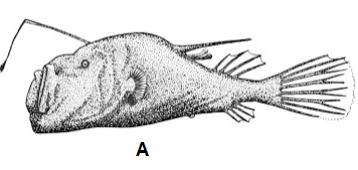
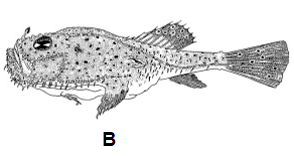
| Angler fish | Genes present in genome |
|---|---|
| A: Ceratias tentaculatus | Cd3z, Cd4, Rag1 |
| B: Chaunax abei | Aicda, Cd3z, Cd4, Cd8a, Cd8b, Rag1 |
| C: Dicertis pileatus | Cd3z, Cd4, Cd8a, Cd8b, Rag1 |
| D: Haplophryne mollis | Cd3z |
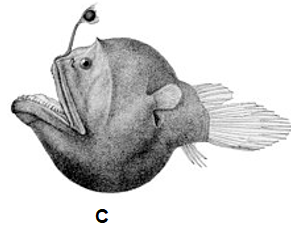
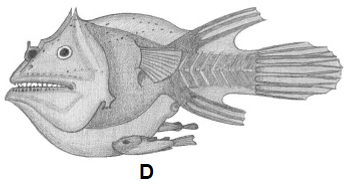
True or False?
Q5.1. All angler fishes have an adaptive immune system which works in a similar way to humans.
Q5.2. Lack of some immune system components could help angler fish male and female bodies to sustainably fuse.
Q5.3. Females of the angler fish Haplophryne mollis (D) use mating strategy 3.
Q5.4. The angler fish Dicertis pileatus (C) has modified B cell immunity.
Q5.5. The angler fish Ceratias tentaculatus (A) has modified T-cell immunity.
Question reproduced from IBO 2023, Theoretical Paper 2, licensed under CC BY-NC-SA 4.0 - attributed to the International Biology Olympiad. Open the full exam PDF