Q22 - ADH1B Allele Geography and Ethanol Metabolism
During the first step of ethanol metabolism in humans, alcohol dehydrogenase (ADH) converts ethanol to toxic acetaldehyde that can accumulate in the body.
ADH1B gene of alcohol dehydrogenase has 2 alleles with varying levels of enzyme activity: ADH1B2 is associated with rapid alcohol metabolism compared to ADH1B1. The ADH1B*2 distribution has a distinct geographical pattern (see Figure 1B).
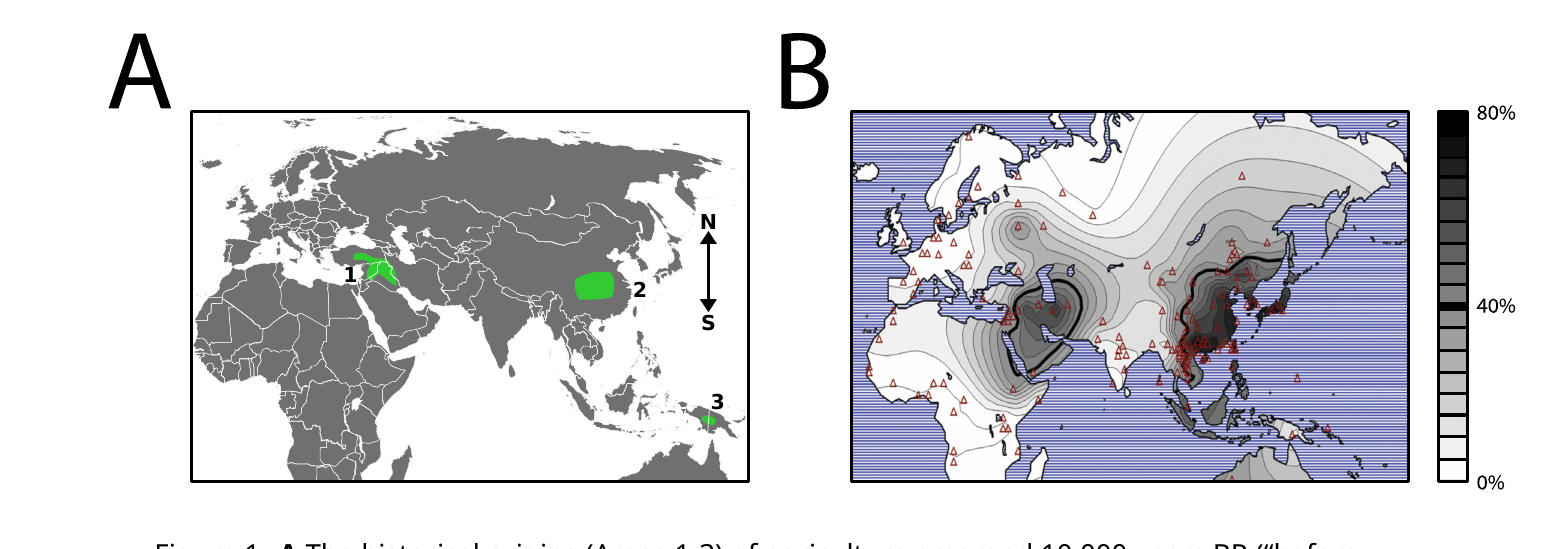 Figure 1. A The historical origins (Areas 1-3) of agriculture emerged 10,000 years BP (“before present”). B Global contour plot of the ADH1B2 allele frequency. The red triangles on the map are points of the data collection.*
On your answer sheet, indicate “T” for true statements and “F” for false ones.
Question reproduced from IBO 2024, Theoretical Exam Part A, licensed under CC BY-NC-SA 4.0 - attributed to the International Biology Olympiad. Open the full exam PDF · Community solutions (unofficial)