Q18 - Ant Invasion, Visibility, and a Lion-Zebra-Buffalo Trophic Cascade
Symbiosis and trophic interactions are essential to maintain ecosystems. In this question, you will analyze the complex ecological relationship between whistling thorn trees, acacia ants (which receive nutrition and shelter from whistling thorn trees), megaherbivores (elephants), predators (lions), and their prey (zebras and buffalos) in an African savanna. You know that between 2000 and 2020, big-headed ants, an invasive ant species exterminating acacia ants, increased in number in the region.
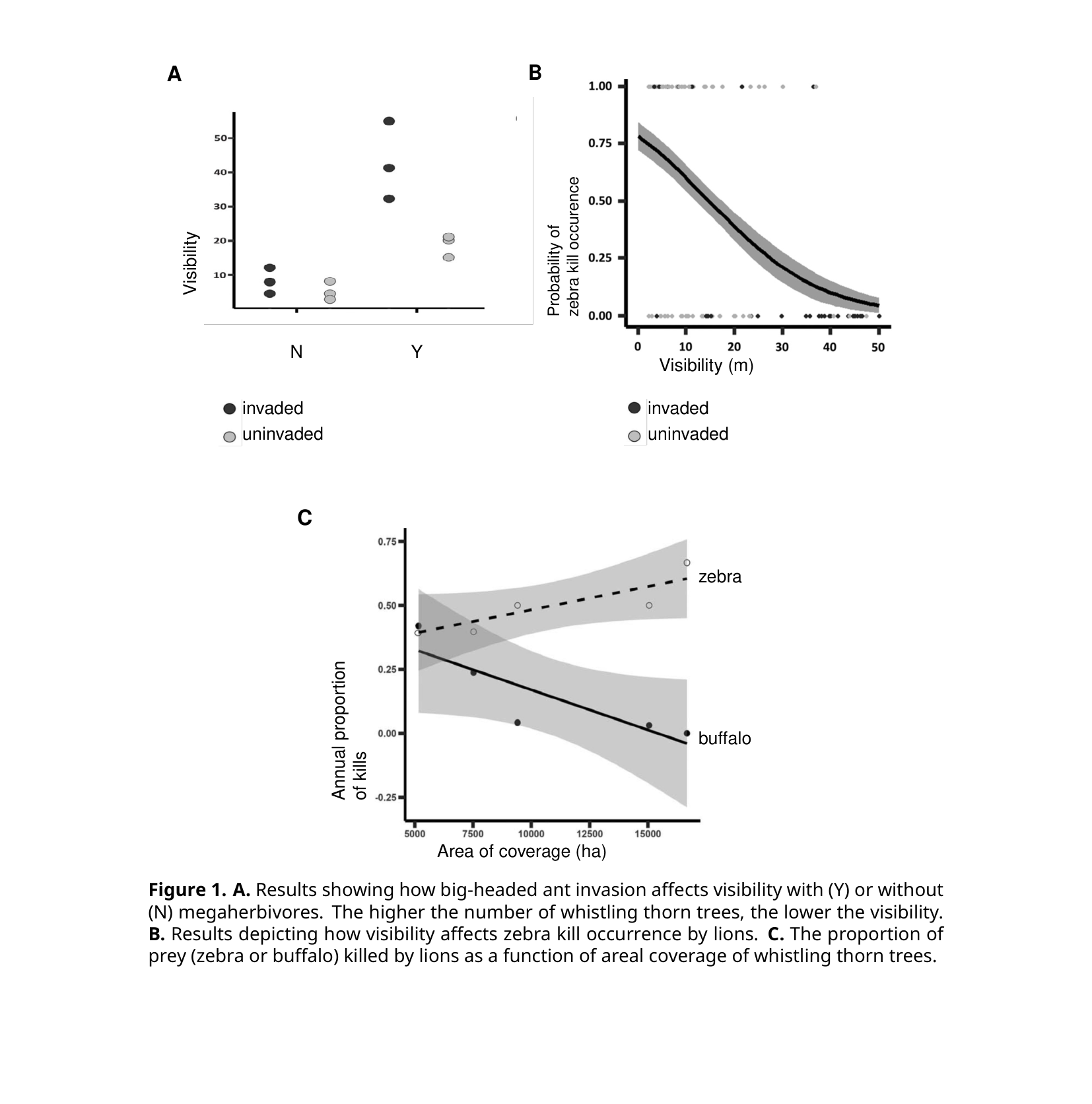 Figure 1. A. Results showing how big-headed ant invasion affects visibility with (Y) or without (N) megaherbivores. The higher the number of whistling thorn trees, the lower the visibility. B. Results depicting how visibility affects zebra kill occurrence by lions. C. The proportion of prey (zebra or buffalo) killed by lions as a function of areal coverage of whistling thorn trees.
On your answer sheet, indicate “T” for true statements and “F” for false ones.
Question reproduced from IBO 2024, Theoretical Exam Part B, licensed under CC BY-NC-SA 4.0 - attributed to the International Biology Olympiad. Open the full exam PDF