Q19 - Heat-Balling Honeybee Defense Against Hornets
Honeybees like Apis cerana (Ac) and Apis mellifera (Am) defend against hornets (Vespa velutina, Vv) by forming a 44°C heat ball and stinging. The effects of heat (25°C or 44°C in thermostatic conditions) and stings from both species on hornet survival were studied. A mutant A. mellifera colony (Amdef) can generate heat but cannot sting and in all other aspects is similar to wild-type ones. Scientists also examined the body mass, venom mass, and stinger length of Ac, Am, and Vv. The figures below show data for wild-type bees.
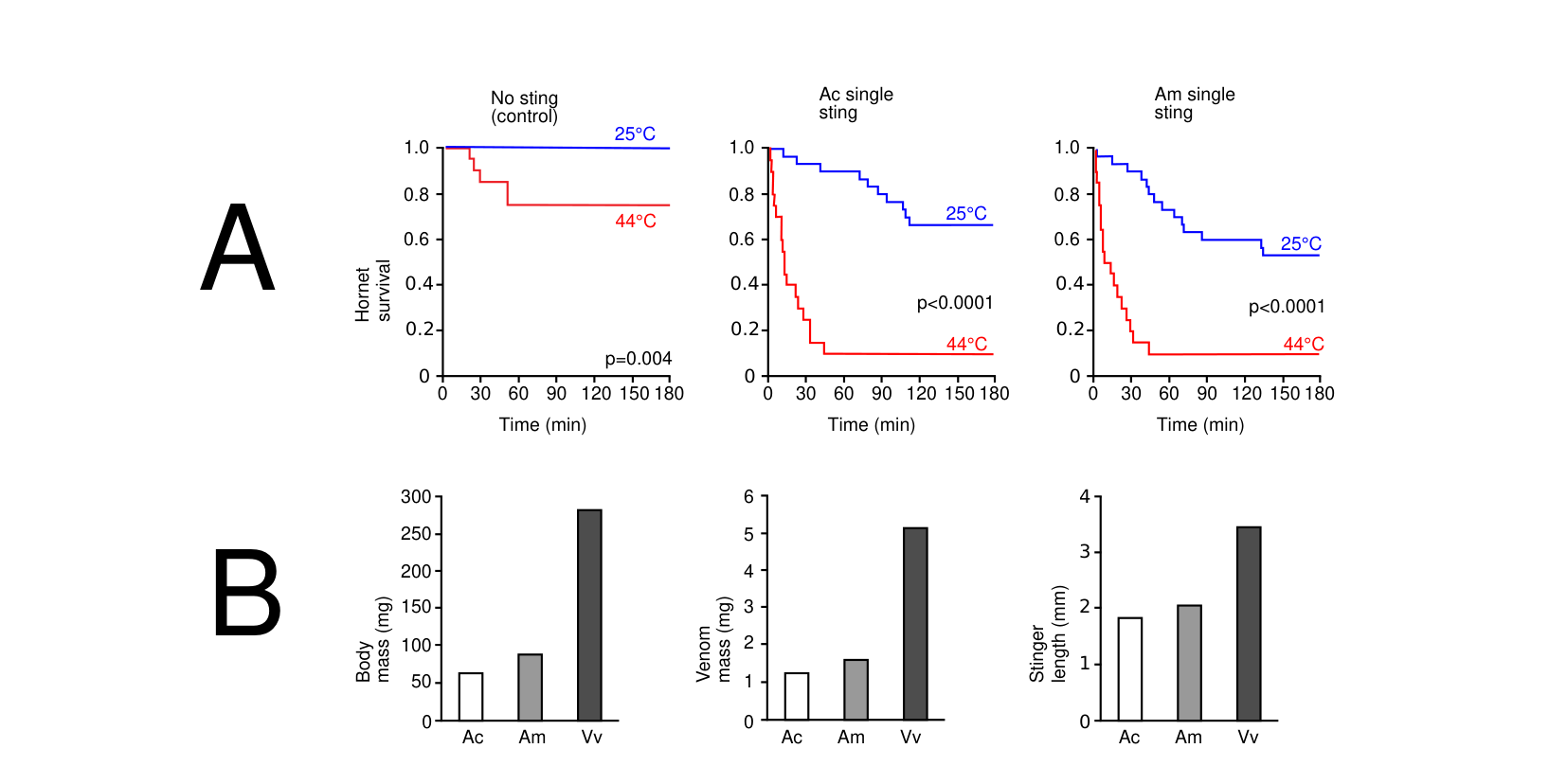 Figure 1. A Graphs show the proportion of surviving hornets over time. p < 0.05 indicates statistical significance. B Body mass, venom mass, and stinger length for three species.
On your answer sheet, indicate “T” for true statements and “F” for false ones.
Question reproduced from IBO 2024, Theoretical Exam Part B, licensed under CC BY-NC-SA 4.0 - attributed to the International Biology Olympiad. Open the full exam PDF