Q36 - CONSTANS, Photoperiod, and Seed Mass
Researchers studied the effect of photoperiod and CONSTANS (CO) protein, a critical mediator of photoperiodic cues, on seed mass and size.
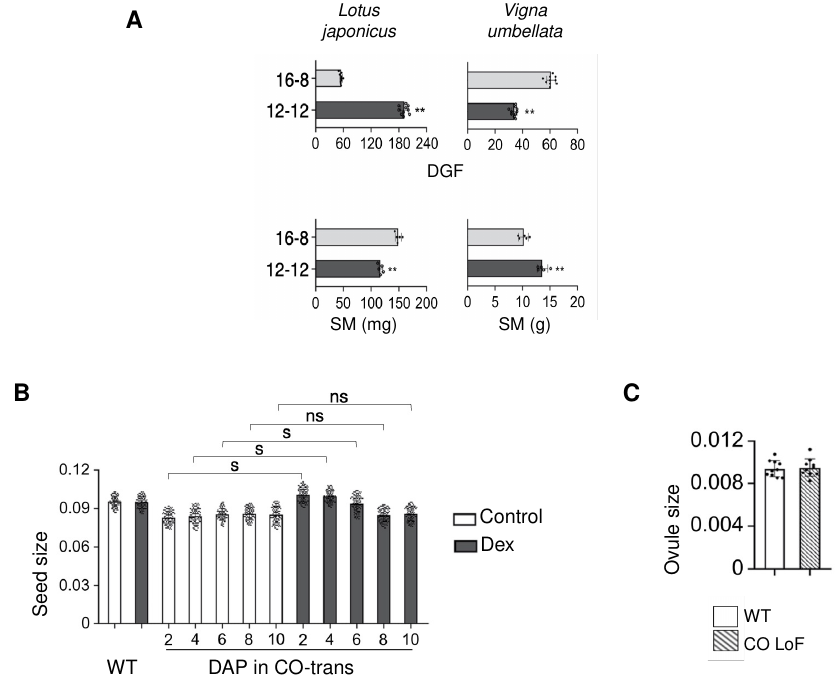 Figure 1. A The flowering time and seed mass of two plant species grown under 16-hour-day/8-hour-night (16-8) and 12-hour-day/12-hour-night (12-12) conditions, representing long-day and short-day photoperiods (DGF: days between germination and flowering; SM: seed mass). B How CO in seeds affects seed size (mm²) in wild-type (WT) and CO-transgenic (CO-trans) seeds, where CO is only functional upon incubating seeds with the compound Dex (DAP: days after pollination; “s”/“ns” denote significant/non-significant differences). C Mature ovule size (mm²) of wild-type (WT) and CO loss-of-function (CO-LoF) mutants.
On your answer sheet, indicate “T” for true statements and “F” for false ones.
Question reproduced from IBO 2024, Theoretical Exam Part B, licensed under CC BY-NC-SA 4.0 - attributed to the International Biology Olympiad. Open the full exam PDF