Q35 - Phytochrome B States, Temperature, and Nuclear Bodies
Phytochrome B (phyB) is a plant photoreceptor responsible for numerous physiological aspects of plant growth. PhyB exists in two states, Pr and Pfr, and the interconversion between them is regulated by red and far-red light (Figure 1A). Interestingly, temperature can also affect the interconversion between Pr and Pfr. At the cellular level, PhyB forms structures called nuclear bodies (NB, Figure 1E).
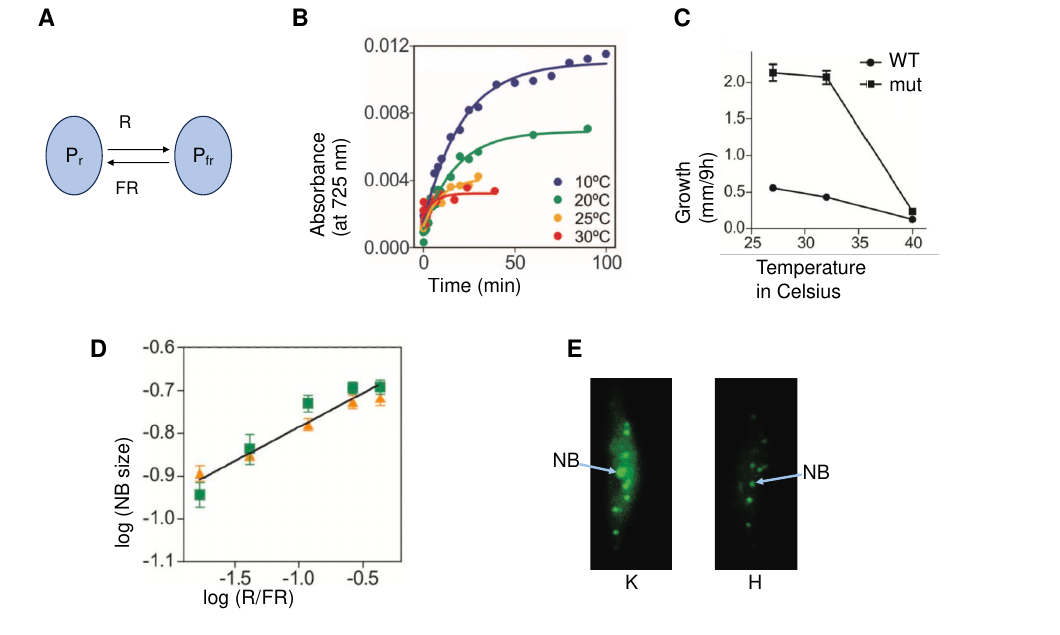 Figure 1. A The control of PhyB states by red (R) and far-red (FR) light. B The effect of temperature on the absorbance of PhyB at 725 nm light (far-red); an equal amount of PhyB was used in each condition. C Hypocotyl growth in wild-type (WT) and phyB null mutant (mut) seedlings. D The impact of the red-to-far-red light ratio on nuclear body (NB) size in temperature-irresponsive PhyB mutants (only light controls Pr/Pfr interconversion in these mutants). E The NBs from two different wild-type plants (K and H) grown under different conditions.
On your answer sheet, indicate “T” for true statements and “F” for false ones.
Question reproduced from IBO 2024, Theoretical Exam Part B, licensed under CC BY-NC-SA 4.0 - attributed to the International Biology Olympiad. Open the full exam PDF