Q44 - Bee Thermoregulation and Body-Size Scaling
Bees can redirect excess heat from the thorax to the abdomen, thus maintaining heat homeostasis. Figure 1A shows body temperature differences due to various outside temperatures for a bee with a large body mass. Figures 1B and 1C show how body mass influences other parameters. Figure 1D shows how thorax temperature affects mass-specific metabolic rate. mut99-bees carry a mutation that impairs both effective thorax cooling and abdomen warming. All graphs below show data for wild-type bees without any mutation.
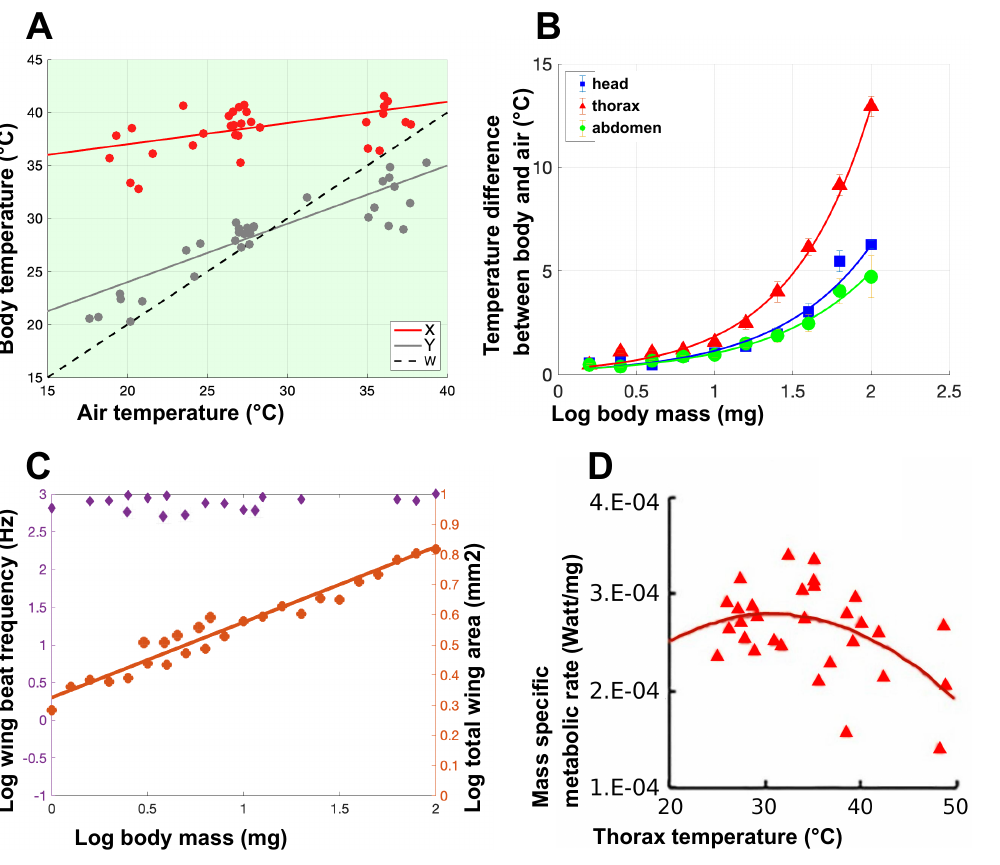 Figure 1. A Body temperature vs. air temperature for a large bee; X - thorax, Y - abdomen, W - dashed unity line (body temperature = air temperature). B Temperature difference between body and air vs. log body mass, for head, thorax, and abdomen. C Log wing-beat frequency and log total wing area vs. log body mass. D Mass-specific metabolic rate (Watt/mg) vs. thorax temperature.
On your answer sheet, indicate “T” for true statements and “F” for false ones.
Question reproduced from IBO 2024, Theoretical Exam Part B, licensed under CC BY-NC-SA 4.0 - attributed to the International Biology Olympiad. Open the full exam PDF