Q48 - mRNA Nucleotide Modifications and Vaccine Design
An mRNA vaccine is a type of vaccine where a pathogenic antigen is encoded in an mRNA sequence. Upon delivery to the human body, cells translate this mRNA and make protein antigens - examples of mRNA vaccines include vaccines developed against the SARS-CoV-2 virus.
Before the development of mRNA vaccines, various forms of RNA nucleotide modifications had been tested for the immunogenic potential of mRNA itself (Figure 1). Note that under normal physiological conditions, RNA can exist outside cells in body fluids.
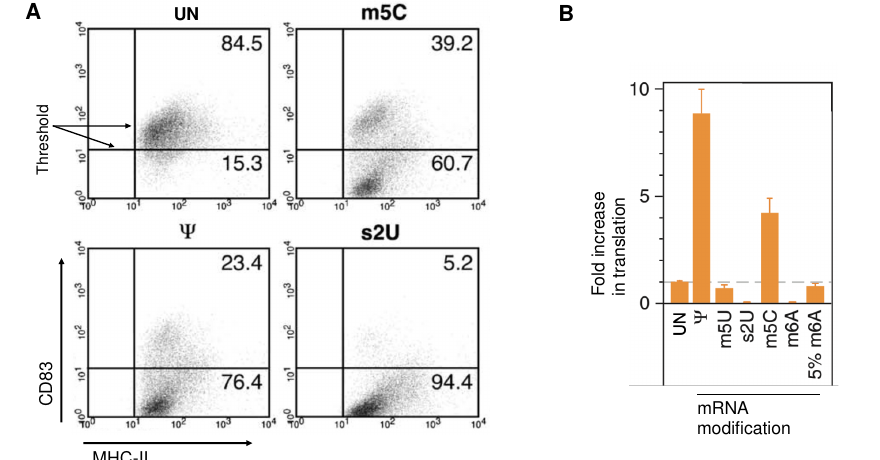 Figure 1. A Activatory response of antigen-presenting dendritic cells to specific RNA nucleotide modifications, recorded as cell-surface receptor levels (UN: unmodified). Each dot represents a single dendritic cell; above the threshold, dendritic cells are activated, expressing higher levels of both CD83 and MHC-II. B Efficiency of modified mRNAs’ translation by cells (UN: unmodified).
On your answer sheet, indicate “T” for true statements and “F” for false ones.
Question reproduced from IBO 2024, Theoretical Exam Part B, licensed under CC BY-NC-SA 4.0 - attributed to the International Biology Olympiad. Open the full exam PDF