Q47 - Cancer Immunotherapy and Checkpoint Inhibitors
Cancer immunotherapy is a cancer treatment approach where the body’s immune cells attack tumor cells. During their development, tumor cells accumulate many neoantigens (new antigens) - the more neoantigens present on the cell surface of tumor cells, the more efficiently immune cells destroy them. An “immune checkpoint” is the primary interaction between an immune cell and a tumor cell, in which the immune cell “decides” whether to attack the tumor cell or not.
However, tumor cells can avoid immune surveillance by hijacking the physiological pathway controlling T-cell activity (Figure 1A). To prevent tumor cells from escaping immune attack, checkpoint inhibitors have been developed (Figure 1A).
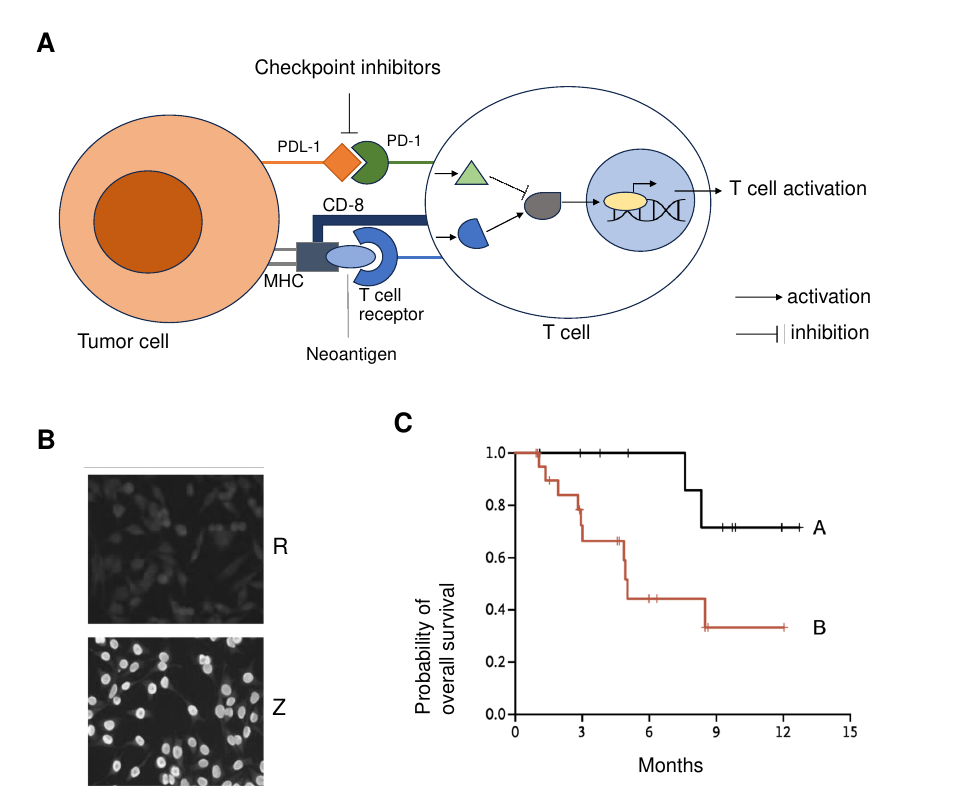 Figure 1. A The interaction between tumor and immune cells. B The serum of two cancer patients (R and Z) was applied to fixed human epithelial cells from a healthy donor; cells were then washed and stained with fluorescently labeled secondary antibodies against human immunoglobulins and visualized by fluorescence microscopy (immunotherapy should be avoided for one of these two patients). C Clinical results of checkpoint-inhibitor treatment on two cancer patient cohorts; the only significant difference between cohorts is the deficiency or proficiency of DNA mismatch repair.
On your answer sheet, indicate “T” for true statements and “F” for false ones.
Question reproduced from IBO 2024, Theoretical Exam Part B, licensed under CC BY-NC-SA 4.0 - attributed to the International Biology Olympiad. Open the full exam PDF