Q50 - Bicoid, Exuperantia, and Body Axis Determination in Drosophila
During Drosophila development, oogenesis establishes the body plan before fertilization.
The concentration gradient of bicoid mRNA in the oocyte determines the anterior-posterior axis (Figure 1A), a process controlled by the Exuperantia protein. Exuperantia anchors bicoid mRNA at the anterior end of the oocyte, preventing its free diffusion and thereby shaping the distribution of bicoid protein in the developing embryo (Figure 1B).
The concentration gradient of the gurken protein (Figure 1C) and its positive interaction with the torpedo protein is critical for determining the dorsoventral axis of the embryo. Interestingly, a wild-type oocyte inside a torpedo-deficient follicle develops into an entirely ventral embryo, while a torpedo-deficient oocyte inside a wild-type follicle develops a normal body plan.
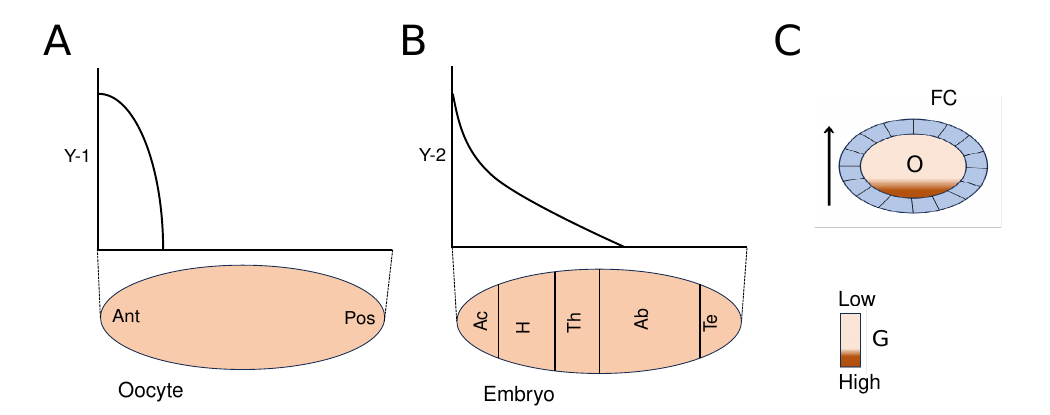 Figure 1. A Y-1: bicoid mRNA concentration; Ant: anterior, Pos: posterior. B Y-2: bicoid protein concentration; Ac: acron, H: head, Th: thorax, Ab: abdomen, Te: telson. C O: oocyte, FC: follicle cells, G: concentration gradient of gurken.
On your answer sheet, indicate “T” for true statements and “F” for false ones.
Question reproduced from IBO 2024, Theoretical Exam Part B, licensed under CC BY-NC-SA 4.0 - attributed to the International Biology Olympiad. Open the full exam PDF