Animal Communication
Overview
A signal in the ethological sense is a specific case of the sign stimulus/releaser concept from Mechanisms of Behavior: a trait or action shaped by natural selection specifically because it influences the behavior of a receiver, distinguished from a cue (a trait a receiver exploits for information but which was not shaped by selection to communicate, e.g. a predator using an unintentional rustling sound to locate prey). This page surveys the sensory channels signals travel through, why some signals can be trusted and others can’t, and how ritualized signals evolve from non-signaling ancestral behaviors, all recurring machinery for the mating (page 6) and social-structure (page 8) pages that follow.
Key Concepts
Signal Modalities
Signals travel through five main channels, each with a characteristic trade-off between transmission distance, speed, persistence, and information content:
- Visual: fast, directional, requires line of sight and light; e.g. the honeybee waggle dance (Karl von Frisch), in which a returning forager’s figure-eight dance angle relative to vertical encodes food-source direction relative to the sun, and dance duration encodes distance, a rare documented case of genuinely symbolic, referential signaling in a non-human animal.
- Auditory, travels around obstacles and works in darkness, moderate persistence; e.g. bird song, whale song, and alarm calls (below).
- Chemical (pheromones): slow to arrive but extremely long-lasting and effective at low concentrations, works in the dark and around obstacles; e.g. moth sex pheromones detectable by males from kilometers away, or ant trail pheromones guiding nestmates to a food source.
- Tactile, short range, private (not broadcast to eavesdroppers), fast feedback; e.g. primate allogrooming, which functions simultaneously as hygiene and as a social-bonding signal (see Aggression, Territoriality & Social Structure).
- Electrical, restricted to aquatic environments and a small set of lineages (weakly electric fish, e.g. mormyrids and gymnotiforms), used for both navigation and species/individual recognition via electric organ discharge waveform.
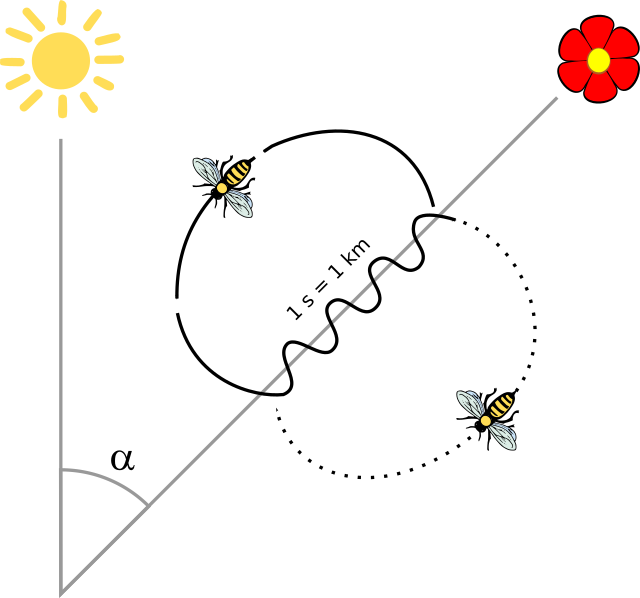 Source: Wikipedia, “Waggle dance”
Honest Signaling vs. Deception
A core theoretical problem in signaling: since signalers can benefit from misleading receivers, why does communication remain broadly reliable rather than collapsing once cheap deceptive signals appear? Two complementary answers are tested:
- The handicap principle (Amotz Zahavi): some signals are reliable specifically because they are costly to produce or costly to survive while carrying, so only genuinely high-quality individuals can afford to produce them at full intensity. The peacock’s train is the standard example: an elaborate, metabolically expensive, predation-risk-increasing display that (the theory argues) is an honest indicator of the male’s overall condition precisely because a low-quality male cannot afford to grow and carry it.

- Deceptive signaling does occur where the cost/reliability logic above doesn’t hold: mimicry-based deception (e.g. Photuris firefly females mimicking the flash pattern of Photinus females to lure and prey on responding Photinus males) and bluffing displays in aggressive contests (an individual signaling higher fighting ability than it actually has) are both documented, and are kept in check evolutionarily only where the average payoff to receivers of ignoring signals entirely would be worse than the cost of occasional deception.

Ritualization
Ritualization is the evolutionary process by which a non-signaling behavior (often one with a direct mechanical or preparatory function) becomes exaggerated, simplified, and stereotyped into a dedicated signal. The classic case is agonistic display evolving from intention movements: a bird’s wing-raising as literal preparation to fly away from a threat becomes, over evolutionary time, an exaggerated, stereotyped “appeasement” or “threat” display used communicatively, disconnected from an actual imminent flight. Ritualized displays typically show three changes relative to their non-signaling ancestral behavior: exaggeration (increased amplitude/duration), stereotypy (reduced variability, becoming more fixed-action-pattern-like, see Mechanisms of Behavior), and emancipation (partial independence from the original motivational/mechanical context that produced the ancestral behavior).
Alarm Calls
Alarm calls are a heavily tested case because they intersect signaling, kin selection (see Kin Selection, Altruism & Eusociality), and honest-signal theory at once. Belding’s ground squirrels (Urocitellus beldingi) give alarm calls at personal risk (the calling individual becomes more conspicuous to the predator), and Paul Sherman’s field studies found calling is more frequent when close kin are nearby, direct field evidence for a kin-selected explanation of a costly signal. Vervet monkeys (Chlorocebus pygerythrus) take alarm calling further into referential signaling: Dorothy Cheney and Robert Seyfarth’s playback experiments showed vervets give acoustically distinct calls for different predator classes (leopard, eagle, snake), and each call type triggers a different, appropriate evasive response in listeners (climbing a tree for the leopard call, looking up for the eagle call, looking down for the snake call) even with no predator actually present, evidence the calls function referentially rather than as a single generic “danger” signal.
Comparative Structures
| Modality | Range | Persistence | Works without light/line of sight | Example |
|---|---|---|---|---|
| Visual | Short-moderate | Very low | No | Honeybee waggle dance |
| Auditory | Moderate-long | Low | Yes | Vervet monkey predator-specific alarm calls |
| Chemical | Long | Very high | Yes | Moth sex pheromones |
| Tactile | Very short | Instantaneous | Yes | Primate allogrooming |
| Electrical | Very short | Instantaneous | Yes (aquatic only) | Mormyrid electric organ discharge |
Common Exam Questions
- “Distinguish a signal from a cue, and explain why an unintentionally rustling leaf betraying a hiding prey animal to a predator does not count as a signal.”
- “Explain the handicap principle using the peacock’s train, including why signal cost is the key feature that keeps the signal honest.”
- “Vervet monkeys give acoustically distinct alarm calls for leopards, eagles, and snakes, each triggering a different escape response. What property of these calls does this demonstrate, and which researchers are associated with this finding?”
- “Explain why Belding’s ground squirrel alarm-calling, despite increasing the caller’s own predation risk, is consistent with a kin-selection explanation.”
- “Describe the process of ritualization using an intention-movement example, and name the three characteristic changes a display undergoes.”
- “Decode a honeybee waggle dance: given a dance angle of 40° to the left of vertical performed in mid-afternoon, what does this indicate about the food source’s direction relative to the hive?”
Visual Reference
Interactive
- Waggle dance decoder (interactive SVG/JS): the user sets a sun position and a dance angle on a stylized vertical comb, and the tool computes and displays the corresponding real-world foraging direction, with dance duration mapped to a distance readout, turning the dance-decoding rule into something manipulable rather than memorized.
- Vervet alarm call playback matcher (audio-triggered HTML/JS, no new library), three labeled call types (leopard/eagle/snake) each paired with the correct evasive-response image, with the calls presented in randomized order for the user to match, mirroring the actual playback-experiment logic Cheney and Seyfarth used.
Static (placed inline in Key Concepts above, next to the concept each one illustrates, rather than collected here.)
Practice Problems
- A species of frog produces a call that is metabolically costly and increases predation risk from bats that eavesdrop on it, yet the call persists evolutionarily because females strongly prefer loud, long callers as mates. Explain this using the handicap principle.
- Explain why a firefly flash-pattern used to lure and prey upon another species is classified as deceptive signaling rather than honest signaling, and what keeps this strategy from being detected and selected against indefinitely by the deceived species.
- A bird’s threat display consists of an exaggerated, stereotyped version of the wing motion it uses to take off. Name the evolutionary process responsible and the three specific changes visible relative to the ancestral behavior.
- Belding’s ground squirrels call more often when surrounded by close relatives than by unrelated individuals. Explain what kind of selection this evidence supports and why an alarm call is a costly behavior worth explaining in the first place.
- Given a honeybee dance performed at a 90° angle to vertical, with the sun position known, describe what real-world compass direction the food source lies in.