Q46 - The Mechanical Function of Buttress Roots
Some trees have large triangular, superficial lateral roots called buttresses (Fig. A). Their functions are widely discussed, but poorly understood. They are more common on trees with an asymmetrical crown; they may prevent windfall (Fig. B); presence of buttresses may also depend on soil type and inclination, and wood density. Their stabilizing importance was tested experimentally (Fig. C).
A, tree with buttress roots; B, a tree with buttresses and vertical tap root pulled over by wind (blue arrow is direction of wind); C, an experimental study of change in anchorage moment for buttressed (left) and non-buttressed trees (right) as a function of the tree’s displacement from vertical (inclination in degrees): red squares are for trees with an intact root system, and blue diamonds for trees, in which all lateral roots (including buttresses, but excluding vertical tap root)) have been cut off (from Crook et al., 1991).
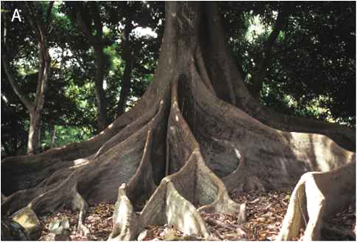 Figure 1.
Using the information and data, determine which of the statements are true or which are false.
Question reproduced from IBO 2015, Theoretical Exam B, licensed under CC BY-NC-SA 4.0 - attributed to the International Biology Olympiad. Open the full exam PDF · Community solutions (unofficial)