Q6 - Desaturase Identity and Ethanol Tolerance in Yeast
Ethanol inhibits microbial growth. Nevertheless, some strains of the yeast Saccharomyces cerevisiae can adapt to high concentrations of ethanol. Many studies have documented the alteration of cellular lipid composition in response to ethanol exposure. In this investigation, we systematically altered the fatty acid composition in S. cerevisiae by knocking out the OLE1 gene coding for an integral membrane desaturase, responsible for the formation of monounsaturated palmitoleic acid (∆9-C16:1) and oleic acid (∆9-C18:1). The knockout strain was then: (1) reconstituted with OLE1 gene by transformation with YEpOLE1 plasmid; (2) transformed with YEp-∆9Hz, YEp-∆9Tn, YEp-∆11Hz or YEp-∆11Tn plasmid containing ∆9 or ∆11 desaturases of two lepidopteran insects (moths) Helicoverpa zea (Hz) or Trichoplusia ni (Tni). Fatty acid composition and growth curves of each transformant were investigated and shown in the table and figure below.
Table Q.6. Composition of major fatty acids in % of S. cerevisiae transformants at mid-log phase.
| Transformant | C16:0 Saturated | C18:0 Saturated | C16:1 Monounsaturated | C18:1 Monounsaturated |
|---|---|---|---|---|
| OLE1 | 45.5 ± 2.2 | 4.7 ± 2.4 | 34.9 ± 0.8 | 14.9 ± 1.0 |
| ∆9Hz | 45.5 ± 5.5 | 7.9 ± 2.2 | 31.7 ± 5.6 | 11.0 ± 2.0 |
| ∆9Tn | 46.9 ± 4.0 | 8.6 ± 3.9 | 12.8 ± 1.9 | 31.7 ± 5.8 |
| ∆11Hz | 45.6 ± 3.6 | 11.9 ± 2.8 | 42.6 ± 6.3 | 0 |
| ∆11Tn | 49.7 ± 4.8 | 12.5 ± 0.1 | 41.8 ± 11.8 | 11.2 ± 1.5 |
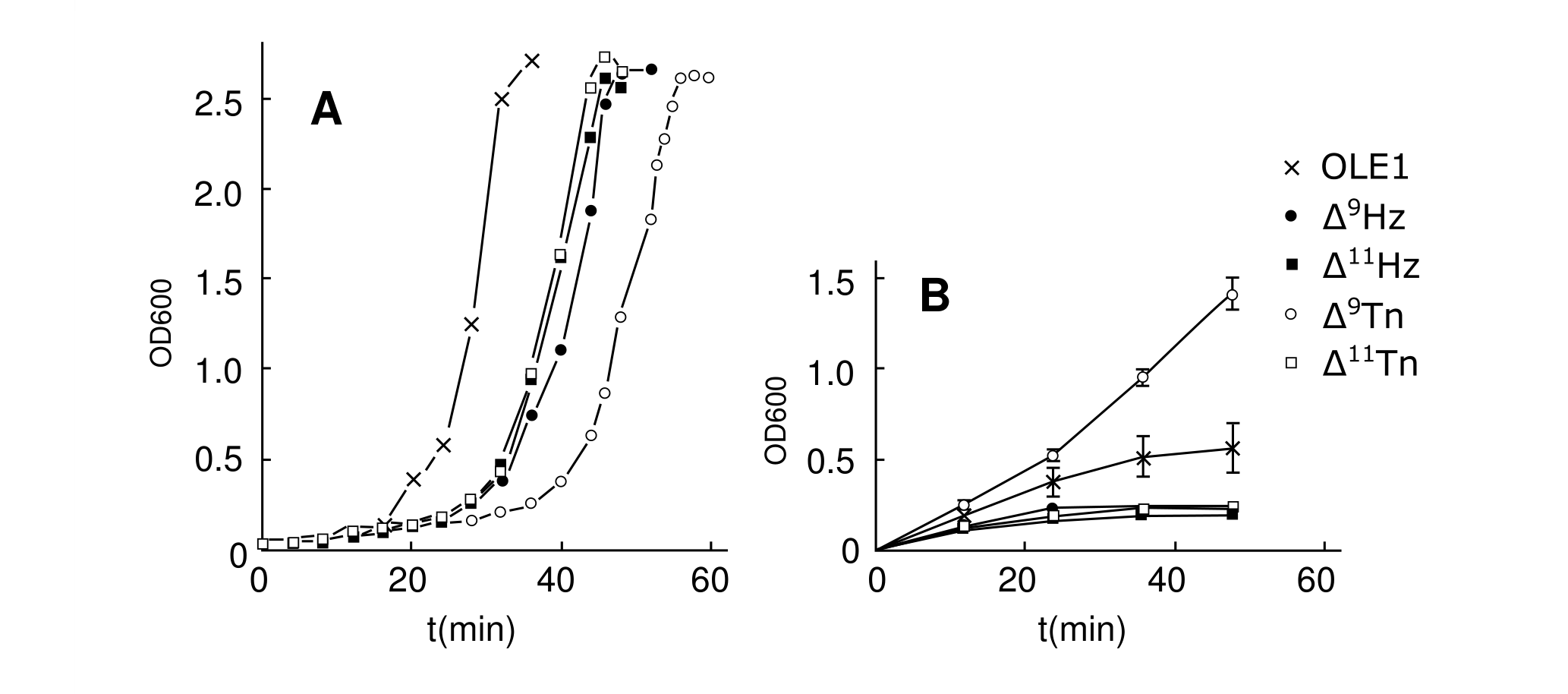 Figure 1.
Using the information and data, determine which of the statements are true or which are false.
Question reproduced from IBO 2016, Theoretical Paper A, licensed under CC BY-NC-SA 4.0 - attributed to the International Biology Olympiad. Open the full exam PDF · Community solutions (unofficial)