Q7 - Feedback Regulation of the PHB Synthesis Pathway
Poly(3-hydroxybutyrate) (PHB) is a bacterial storage material which is accumulated by various bacteria, usually when grown under limitation of a nutrient such as oxygen, nitrogen, phosphate, sulphur, or magnesium and in the presence of excess carbon. Fig. Q7 shows the PHB synthesis pathway of Ralstonia eutropha from acetyl-CoA, which is regulated by feedback inhibition. In addition, acetyl-CoA can enter the citric acid cycle.
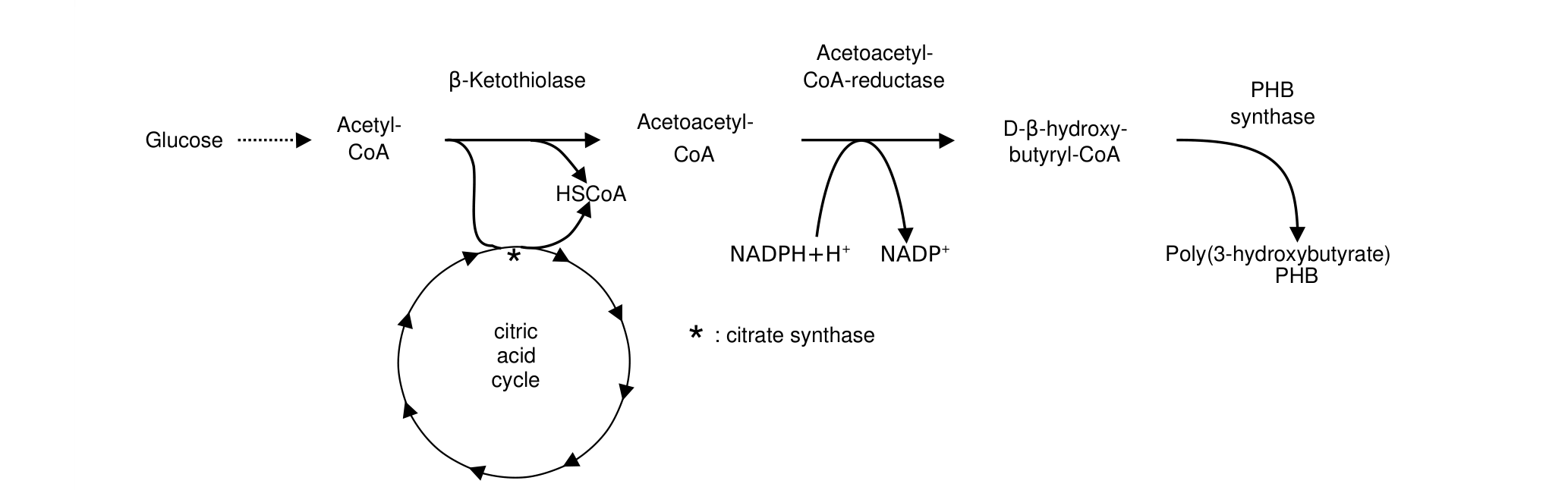 Figure 1.
Using the information and data, determine which of the statements are true or which are false.
A. The increase in activity of citrate synthase will reduce the production of PHB.
B. When the intracellular concentration of HSCoA is high, the rate of PHB synthesis will increase.
C. When the rate of PHB synthesis increases, the growth rate of Ralstonia eutropha cells will also increase.
D. PHB synthesis is stimulated by low ratios of (NADPH+H+)/NADP+.
Question reproduced from IBO 2016, Theoretical Paper A, licensed under CC BY-NC-SA 4.0 - attributed to the International Biology Olympiad. Open the full exam PDF · Community solutions (unofficial)