Q64 - Diurnal Light and CO2 Co-Limitation of Underwater Photosynthesis
Photosynthesis of submerged aquatic plants is severely impeded by many environment factors. In seawater and freshwater, light density and its spectrum is changed with depth in the water column and thus influence photosynthesis. Other factors affecting photosynthesis include level of carbon dioxide (CO2) and oxygen (O2).
Swamp Raspwort (Meionectes brownii) is a wetland plant species but can grow as a submerged aquatic plant in freshwater. An experiment was conducted to study the photosynthesis of the aquatic vegetation. Diurnal fluctuations in surface irradiance, partial pressure of O2, CO2 concentration and pH of the water in Swamp Raspwort- rich ponds are shown in Figure Q.64.
Figure Q.64
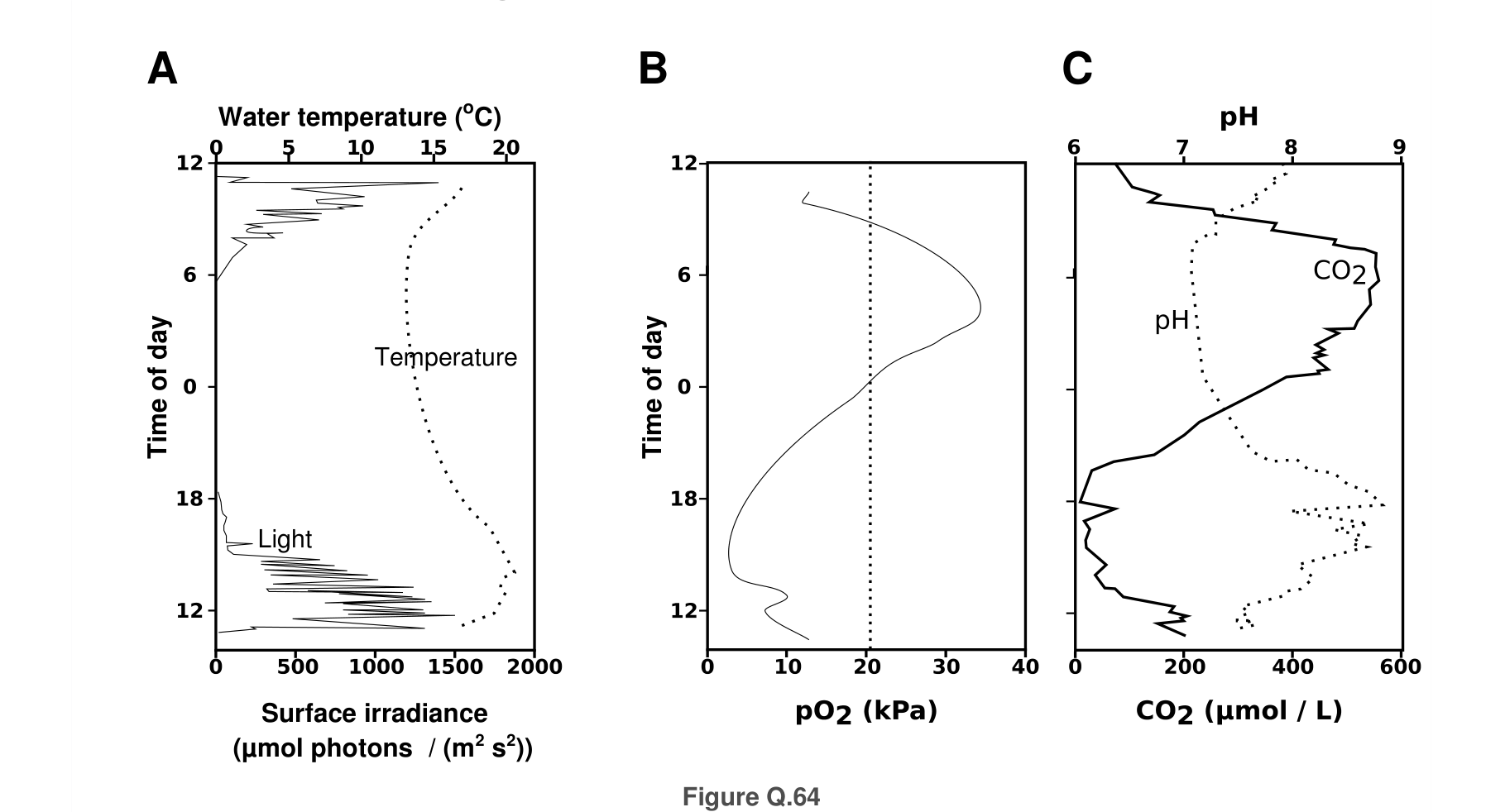 Figure 1.
Using the information and data, determine which of the statements are true or which are false.
Question reproduced from IBO 2016, Theoretical Paper B, licensed under CC BY-NC-SA 4.0 - attributed to the International Biology Olympiad. Open the full exam PDF · Community solutions (unofficial)