Q65 - Nitric Oxide Feedback in Plant Nitrate Assimilation
Nitrogen assimilation plays an important role in plant metabolism as well as in plant cell development. Plant cells can acquire inorganic nitrogen in the form of ammonium (NH4+) and nitrate (NO3-). When entering the plant cells through membrane-bound nitrate transporter (NRT), NO3- can be reduced to NO2- by nitrate reductase (NR) and subsequently to NH4+ and amino acids (AA). In addition, NO2- can be converted into nitric oxide (NO), then forming S-nitrosoglutathione (GSNO) by reaction with glutathione (GSH), and finally into oxidized glutathione (GSSG) and NH4+ under catalysis of S-nitrosoglutathione reductase 1 (GSNOR1).
Figure Q.65 A schematic model for the control of nitrogen assimilation in plants through NO signalling.
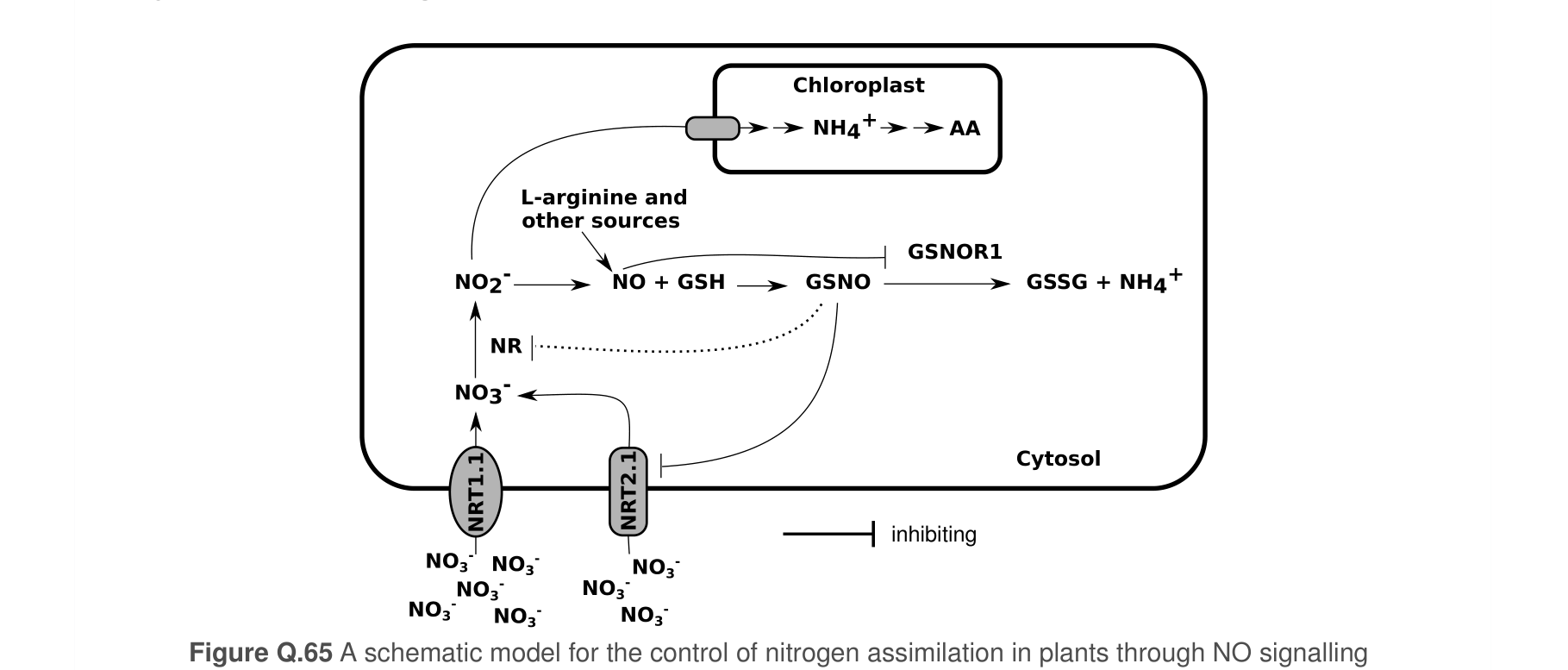 Figure 1.
Using the information and data, determine which of the statements are true or which are false.
Question reproduced from IBO 2016, Theoretical Paper B, licensed under CC BY-NC-SA 4.0 - attributed to the International Biology Olympiad. Open the full exam PDF · Community solutions (unofficial)