Q68 - Hormonal Correlates of the Cucumber Super-Ovary Phenotype
Scientists grew cucumber plants in different nutrient conditions to obtain either super ovary or normal ovary types. They labelled flowers when they emerged and observed the development of flowers. Based on the color and shape, corolla development was divided into four consecutive stages: green bud (G), green-yellow bud (GY), yellow bud (Y), and flowering (F). They also measured plant growth regulator concentrations in different flower developmental stages.
Fig.Q.68 A-D: Morphological characterization of the normal ovary and super ovary types, including corolla-stage progression over time, ovary length at anthesis, and fruit length at matched days after labeling. E-J: Concentration of cytokinins (iPA, ZR, DHZR), gibberellins (GA3, GA4) and auxin (IAA) in different flower developmental stages. In the super ovary type, two sub-stages were included. Double asterisks indicate statistically significant differences within one developmental stage.
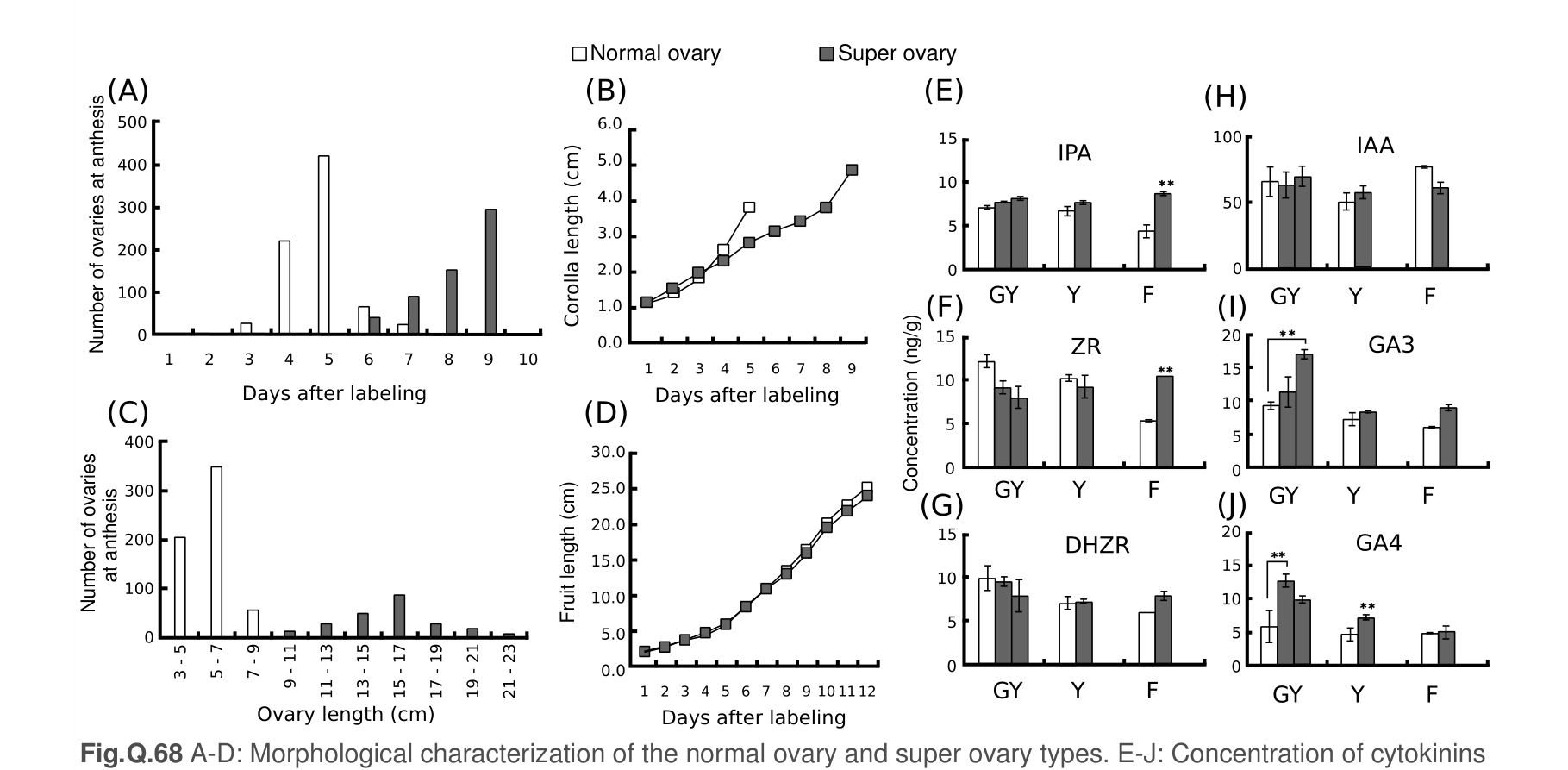 Figure 1.
Using the information and data, determine which of the statements are true or which are false.
Question reproduced from IBO 2016, Theoretical Paper B, licensed under CC BY-NC-SA 4.0 - attributed to the International Biology Olympiad. Open the full exam PDF · Community solutions (unofficial)