Q82 - Female Choice and Interspecific Hood-Burrow Sharing in Fiddler Crabs
The behaviour of two similar-sized species of fiddler crabs (Uca latimanus and U. musica) that intermingle in the same habitat was studied. Males build hoods over their burrows for mate attraction. Mate searching is a dangerous activity for fiddler crab females, so these females may be forced to make suboptimal choices for their own safety, especially in areas where their conspecifics are in lower densities. The figures Fig.Q.82 below show the approaches made by females of the two species to male crabs as well as to burrows (with and without hoods) of conspecific males.
Fig. Q.82: (A) Mean (±SE) proportion of resident Uca latimanus and U. musica males approached by wandering U. latimanus females and U. musica females. (B) Mean (±SE) proportion of resident conspecific males with and without hoods approached by wandering U. latimanus females and U. musica females.
Indicate in the answer sheet if each of the following statements is true or false.
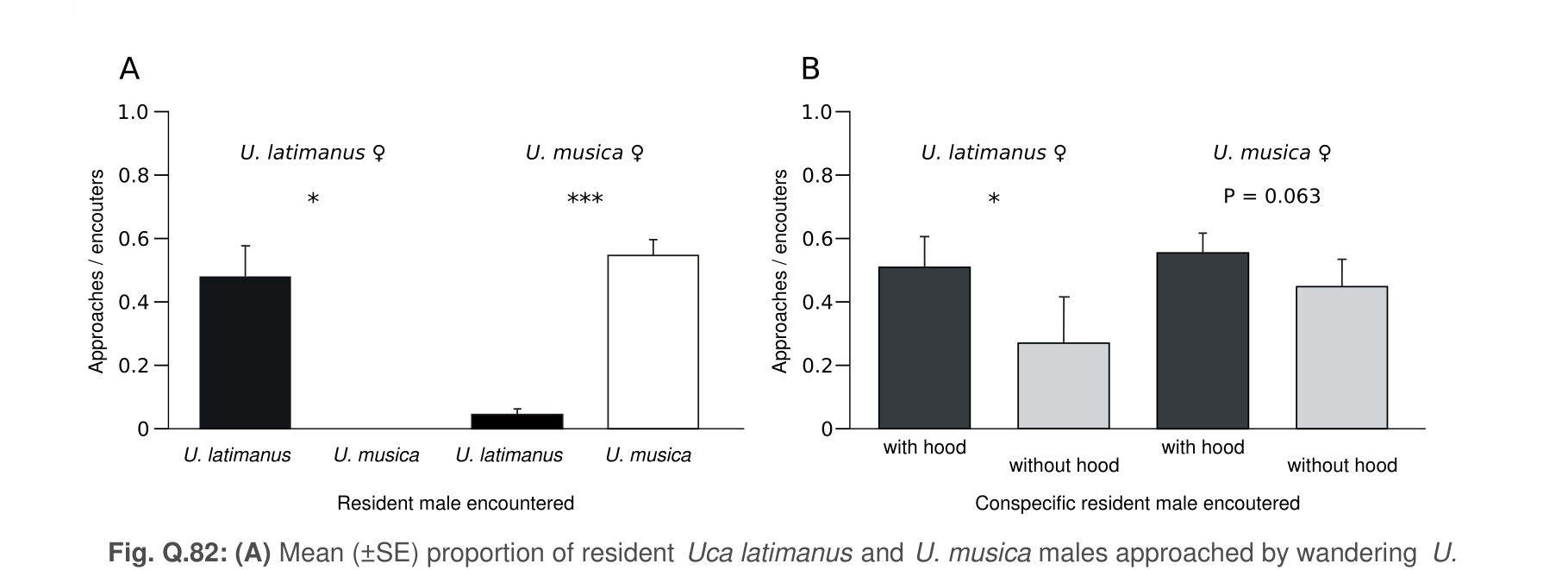 Figure 1.
Using the information and data, determine which of the statements are true or which are false.
Question reproduced from IBO 2016, Theoretical Paper B, licensed under CC BY-NC-SA 4.0 - attributed to the International Biology Olympiad. Open the full exam PDF · Community solutions (unofficial)