Q94 - How Many DBH Categories Are Needed to Accurately Age a Tree?
Scientists constructed models for four threatened tree species in sub-tropical forests in Vietnam, and used these models to estimate tree ages (figure Q.94). Tree age is measured by ring count and trunk diameter at breast height (DBH). Rates of growth were categorised using changes in DBH from 10 to 1000, with 1000 at the finest- grain measure of change.
Figure Q.94. Estimated (lines, for the 10-, 100-, and 1000-category DBH models) and observed (circles, from ring counts) ages for the four tree species Annamocarya sinensis, Calocedrus macrolepis, Dacrydium elatum, and Pinus kwangtungensis.
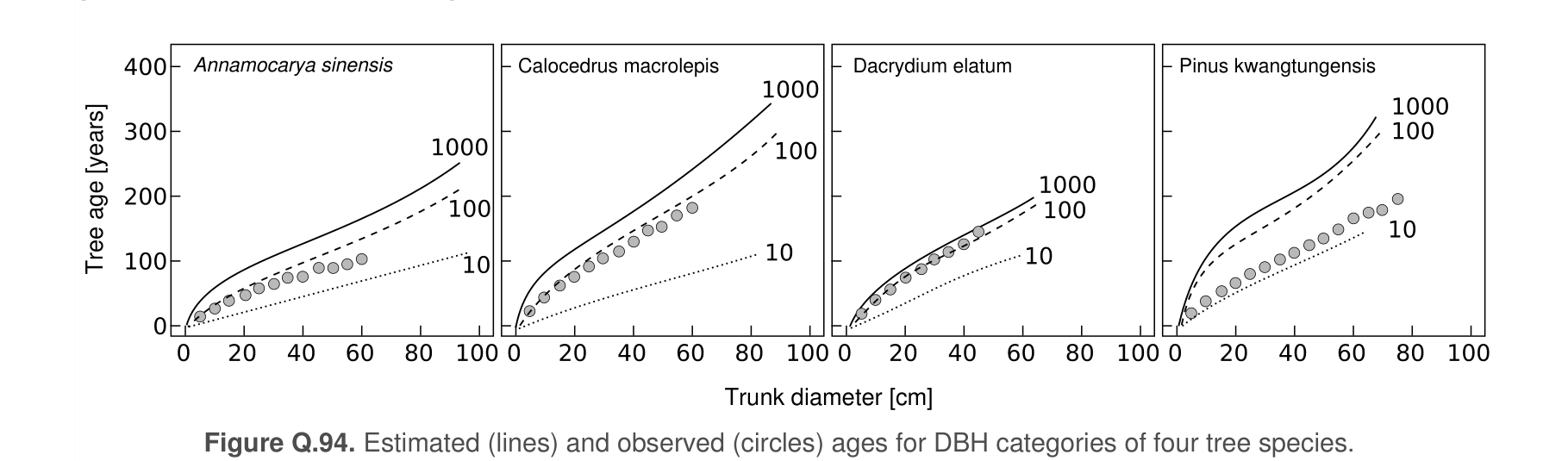 Figure 1.
Using the information and data, determine which of the statements are true or which are false.
Question reproduced from IBO 2016, Theoretical Paper B, licensed under CC BY-NC-SA 4.0 - attributed to the International Biology Olympiad. Open the full exam PDF · Community solutions (unofficial)