Q59 - Mapping p35 Phosphorylation Sites with a Phospho-Tag Gel
Phosphorylation is a major post-translational modification widely used in the regulation of many cellular processes. A method to determine the phosphorylation status of proteins is to run an electrophoresis in a modified gel with a chemical group containing metal ions (M) that can reversibly bind phosphates and thus affects migration of phosphorylated proteins.
Figure Q.59.A Phospho-tag polyacrylamide gel
This technique was used to study the phosphorylation of protein p35. Three mutant forms of this protein were generated: a serine to alanine substitution in position 8 (S8A); a threonine to alanine substitution in position 138 (T138A) and both amino acid substitutions (2A). Note that serine and threonine can be phosphorylated while alanine cannot. Then two yeast strains with normal (wt) or inactive cyclin-dependent kinase 5 (Cdk5) (kn) were transformed with either the wild type version of p35 gene (wt) or one of the three mutant forms. Cell lysate of the eight resulting strains was loaded on a Phospho-tag gel. The proteins from the gel were transferred by western- blot to a membrane that was treated with anti-p35 antibodies. The result is shown below.
Figure Q.59.B Immunoblotting with anti-p35. The arrow indicates the direction of migration. p35 bands are named M1, M2, L1, L2, L3, and L4. L4 band corresponds to the completely non-phosphorylated form of p35.
 Figure 1.
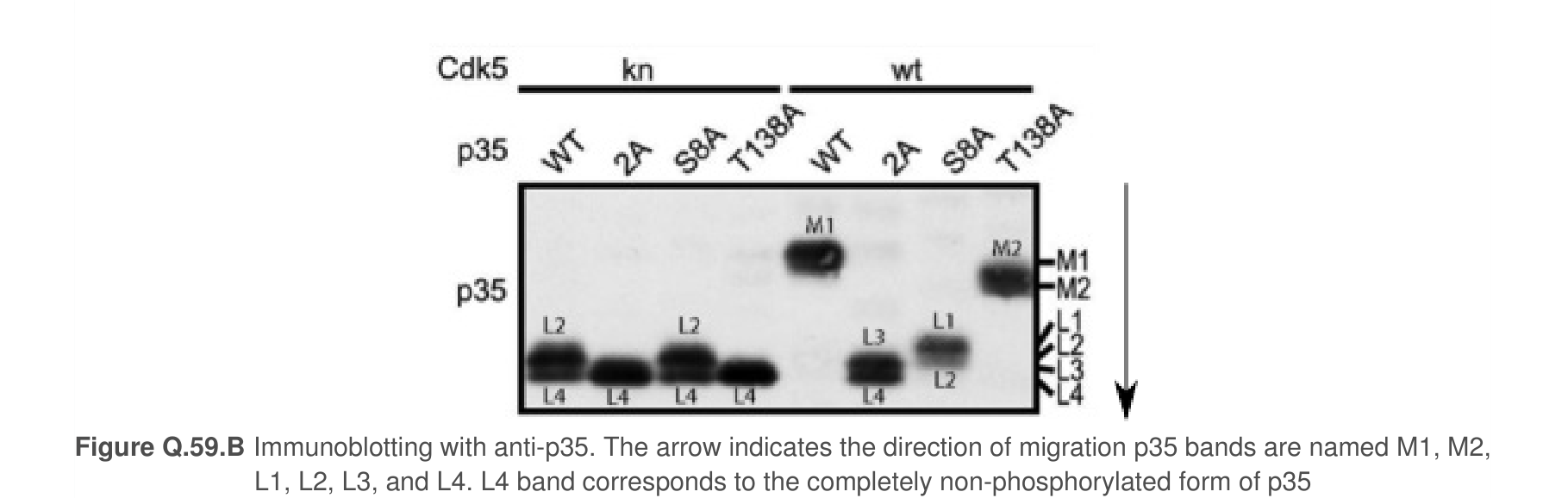 Figure 2.
Using the information and data, determine which of the statements are true or which are false.
Question reproduced from IBO 2016, Theoretical Paper B, licensed under CC BY-NC-SA 4.0 - attributed to the International Biology Olympiad. Open the full exam PDF · Community solutions (unofficial)