Q7 - Designing a CRISPR Knockout of Gene X
Michael Smith (1932-2000) invented site-directed mutagenesis. Recently scientists invented CRISPR- Cas9 technology to carry out mutagenesis more easily. Cas9 protein from Streptococcus pyogenes is guided by a 20bp guideRNA which base-pairs with target DNA. This Cas9 enzyme can only make double strand cuts in DNA three bases upstream from a 5’-NGG-3’ site (1). Double strand cuts are attacked by DNA degrading enzymes, and then re-joined. Gene X, which you want to stop from functioning with this enzyme, is shown (2). An alternative way to knockout genes is to use a pair of modified Cas9’s which can only make single strand cuts, and guideRNA’s which target adjacent sites.
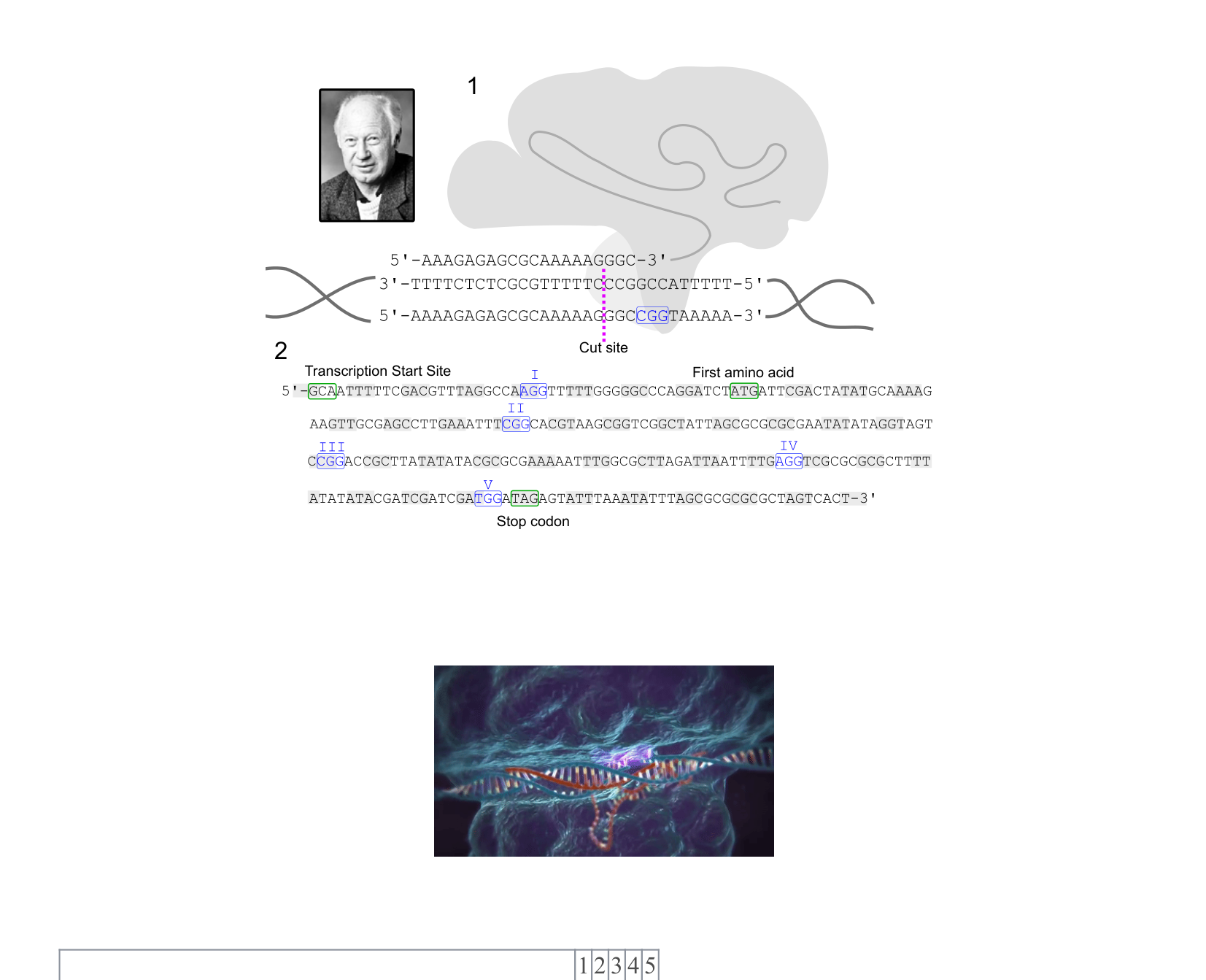
This question mixes multiple-choice/numeric-estimate parts with True/False statements - answer each part using the information and data above.
Question reproduced from IBO 2017, Theoretical Exam A, licensed under CC BY-NC-SA 4.0 - attributed to the International Biology Olympiad. Open the full exam PDF · Official answer key & worked solutions