Q34 - p53's Tetramer Threshold Guards Against Cancer
The major ways by which the cell-cycle is regulated in all eukaryotes were discovered by British scientists. In humans, Cyclins (discovered by Sir Tim Hunt; 1943-present) are transcribed at specific cell-cycle stages, and bind cyclin-dependent kinases (CDK; discovered by Sir Paul Nurse; 1949-present), to coordinate division. Protein-53 (p53; discovered by Sir David Lane; 1952-present) is activated by a huge array of post-translational modifications, which allows it to exert diverse effects. p53 can exert these effects even when its activity is reduced by half, but each p53 monomer is only active when bound to three other functional p53 monomers in a homotetramer. p53 is mutated in the majority of cancers ever sequenced.
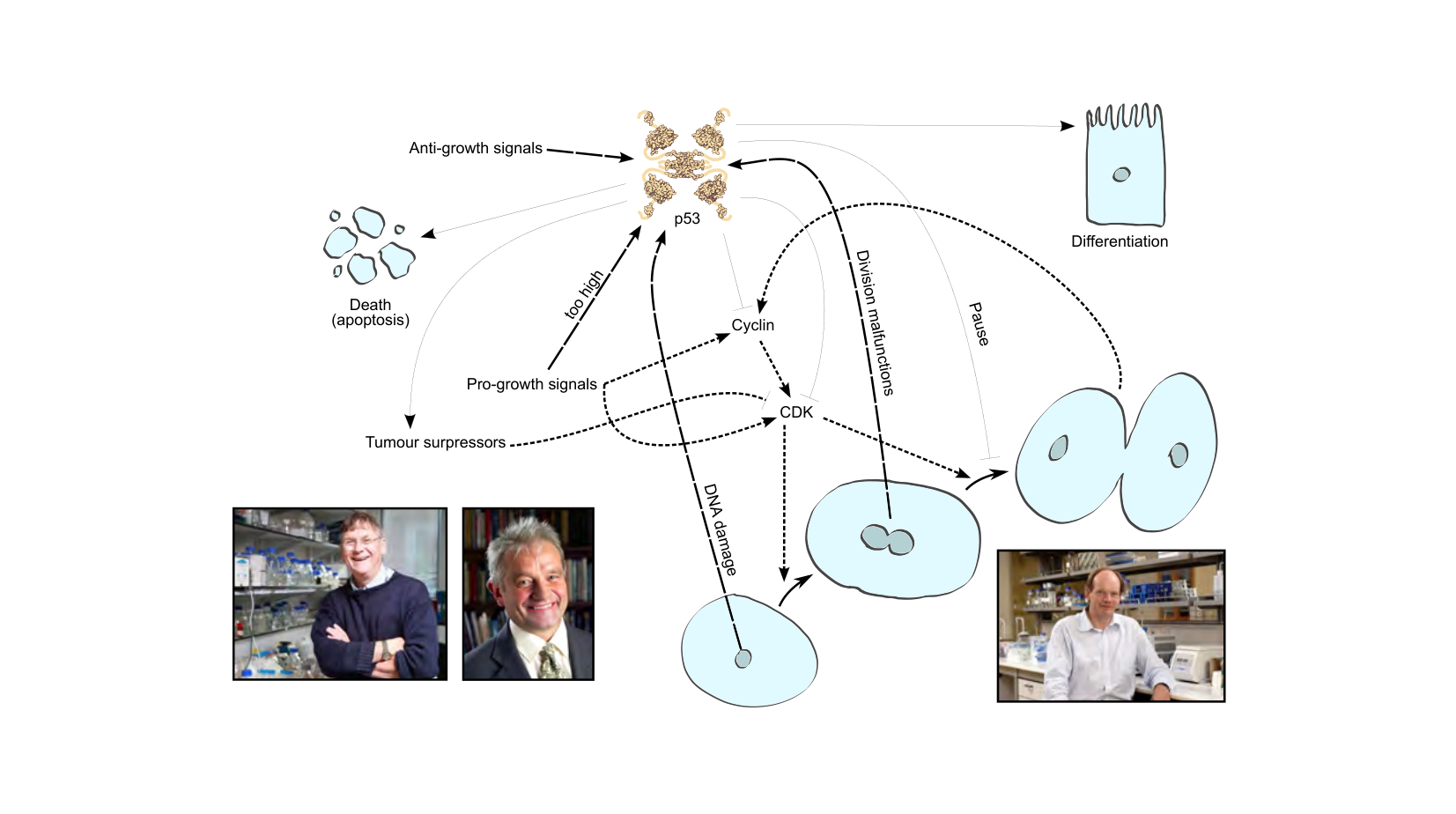
Using the information and data, determine which of the statements are true or which are false.
Question reproduced from IBO 2017, Theoretical Exam B, licensed under CC BY-NC-SA 4.0 - attributed to the International Biology Olympiad. Open the full exam PDF · Official answer key & worked solutions