Q18 - Light Refraction in the Four-Eyed Fish Anableps
When a light beam enters another medium in an oblique angle, its direction will change. This phenomenon is called light refraction. The amount of this change in beam direction can be calculated by Snell’s law, where “n” is the refraction index. This phenomenon is also the principle of conversion and diversion of beams in lenses. Power of a lens can be calculated by the following formula. Optical power of a lens demonstrates the degree of convergence or divergence of the light beam. D = (n1 - n2)/r, where D is power of lens and r is radius of curvature. The figure below shows the eye structure of Anableps sp. which can simultaneously see objects in both aquatic and terrestrial scenes. A) Anableps sp. B) Eye of Anablebs sp. C) Schematic diagram of Anableps. sp. eye
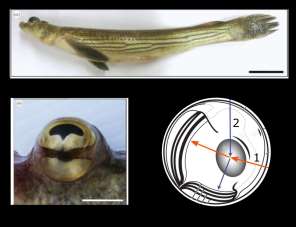 Figure 1.
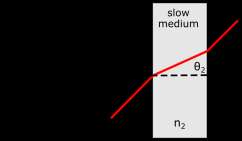 Figure 2.
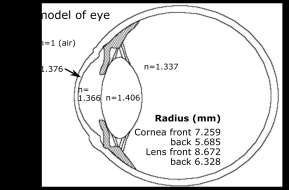 Figure 3.
Using the information and data, determine which of the statements are true or which are false.
Question reproduced from IBO 2018, Theoretical Paper 1, licensed under CC BY-NC-SA 4.0 - attributed to the International Biology Olympiad. Open the full exam PDF · Community solutions (unofficial)