Q4 - Pulse-Chase RNA Processing
Pulse-chase experiments performed in cells are experiments in which cells are first exposed to labelled precursors of specific molecules for a short period of time (the pulse), unincorporated labelled precursors are then washed away, and presence of label in molecules of interest are followed through time (the chase). In an experiment designed to study gene expression, cells were exposed to labelled UTP during the pulse, and results of the chase part of the experiment are summarized in the figure below.
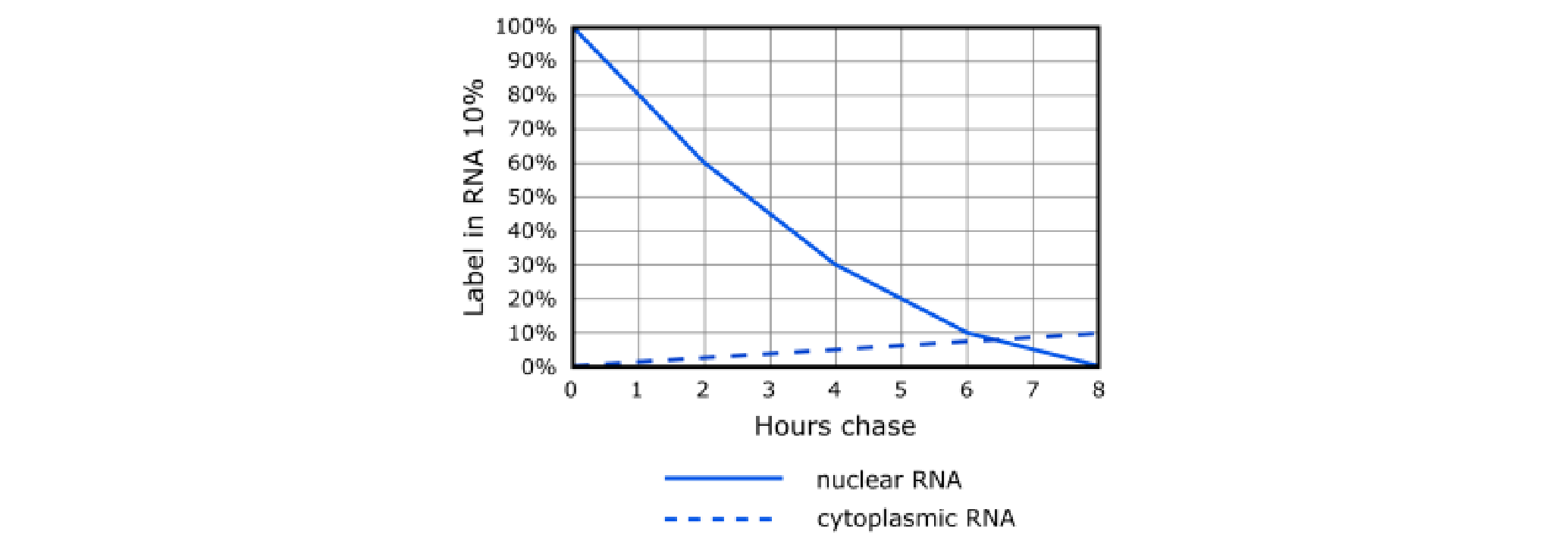 Figure 1.
Using the information and data, determine which of the statements are true or which are false.
Question reproduced from IBO 2018, Theoretical Paper 1, licensed under CC BY-NC-SA 4.0 - attributed to the International Biology Olympiad. Open the full exam PDF · Community solutions (unofficial)