Q12 - A FRET-Based Quantum Dot Maltose Biosensor
Forster resonance energy transfer (FRET) is a distance-dependent process whereby energy from an excited fluorescent molecule (donor) is transferred to a second, non-excited molecule (acceptor) in its vicinity. The FRET efficiency depends on the spectral overlap of the donor emission spectrum and the acceptor absorption spectrum. Acceptors in various forms of FRET may or may not emit fluorescence after receipt of energy from donor. Quantum dots (QDs) are fluorescent nanoparticles that can act as FRET donors and can be used in biosensor systems. The binding of some molecules to QDs enhances the emission properties of the QDs. In this study, 560 nm emitting QDs (QD-560) were used. Maltose Binding Protein (MBP)- bounded QD-560 has higher emission than unbound QD-560. The effect of native MBP or penta-histidine tagged MBP (MBP-5His) binding to QD-560 on fluorescence intensity was tested over a range of protein-to-QD ratios (Figure 1). Histidine residues can bind zinc ions present on the surface of the QD particles. For construction of a Maltose detecting biosensor, the saccharide binding pocket of each QD- coordinated MBP-5His was preloaded with a maltose analogue named beta-cyclodextrin bound to QSY9 (beta-CD-QSY9); the QSY9 component absorbs light. Figure 2 shows the biosensor.
 Figure 1.
 Figure 2.
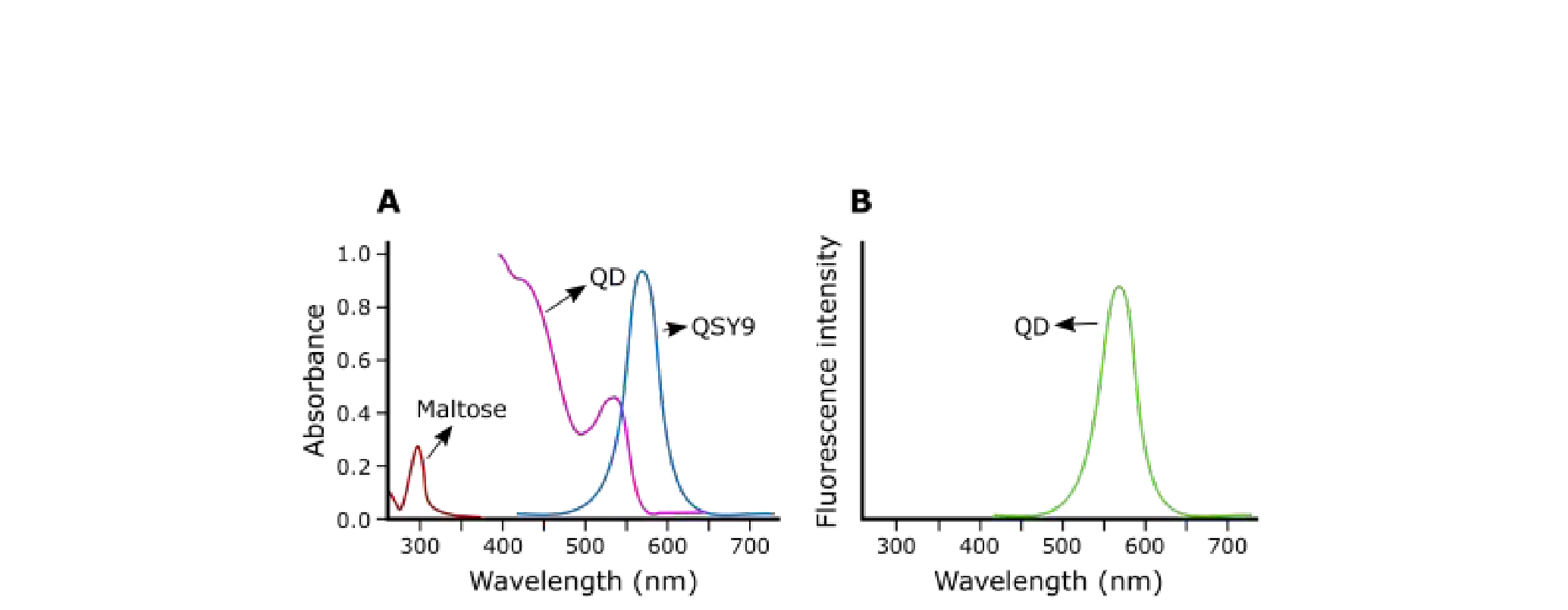 Figure 3.
Using the information and data, determine which of the statements are true or which are false.
Question reproduced from IBO 2018, Theoretical Paper 2, licensed under CC BY-NC-SA 4.0 - attributed to the International Biology Olympiad. Open the full exam PDF · Community solutions (unofficial)