Q28 - Tunicate Body Plan and Chordate Affinities
Five distinctive characteristics that, taken together, set chordates apart from all other phyla are notochord, dorsal tubular nerve cord, pharyngeal pouches or slits, an iodine secreting organ (endostyle), and post-anal tail. These characteristics are always found at some embryonic stage, although they may be altered or may disappear in later stages of the life cycle. Tunicates belong to Deuterostomia group of Metazoa and are found in all seas from near shoreline to great depths. Most are sessile as adults, although some are free-living. The name “tunicate” refers to the usually tough and non-living tunic that surrounds the animal and contains cellulose-like components. As adults, tunicates are highly specialized chordates, for in most species only the larval form, which resembles a microscopic tadpole, bears all the chordate hallmarks. Tadpole undergoes metamorphosis and changes its morphology and anatomy. Structure of a common tunicate, Ciona sp.
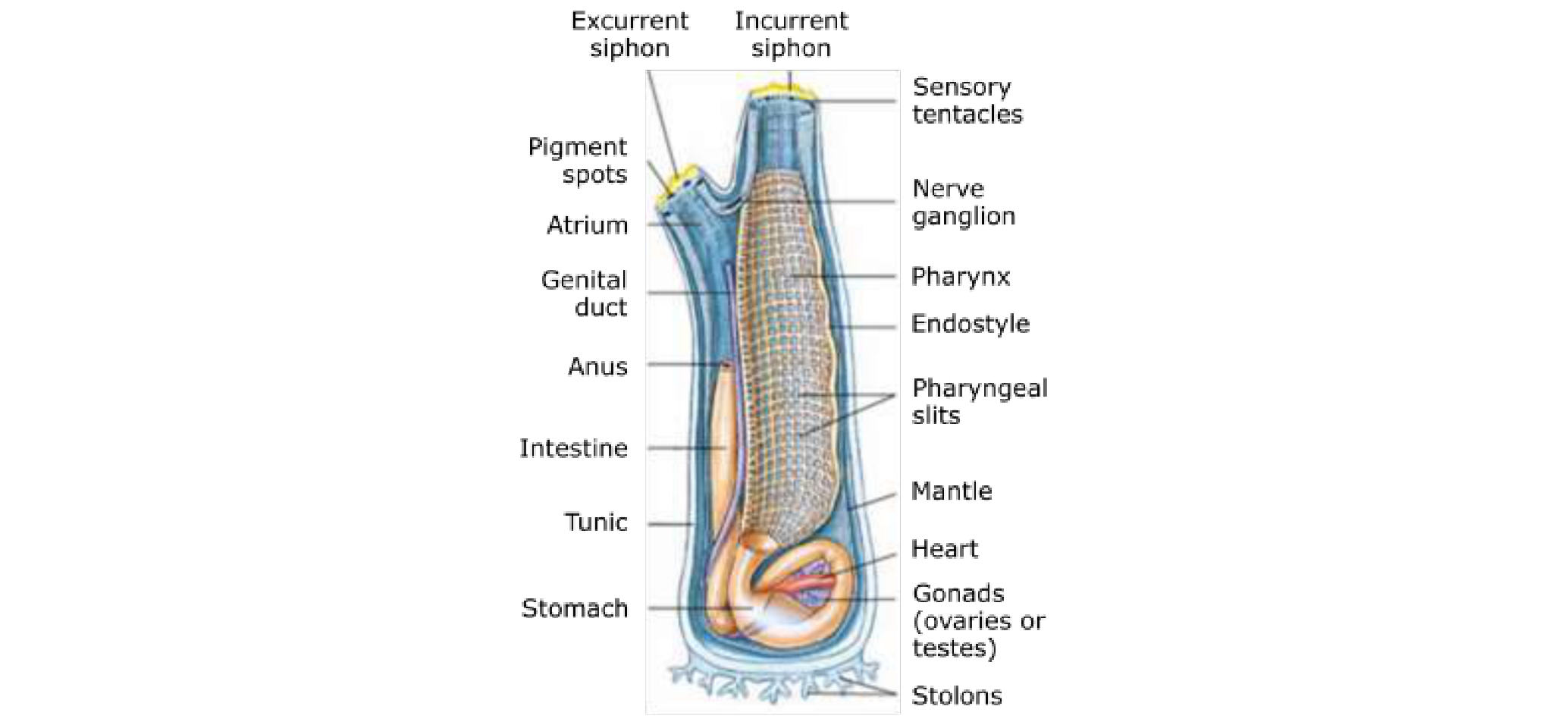 Figure 1.
Using the information and data, determine which of the statements are true or which are false.
Question reproduced from IBO 2018, Theoretical Paper 2, licensed under CC BY-NC-SA 4.0 - attributed to the International Biology Olympiad. Open the full exam PDF · Community solutions (unofficial)