Cell Theory, Prokaryotes & Eukaryotes
Overview
This is the section’s foundational page; read it first. Cell theory states that all living organisms are composed of cells, the cell is the basic structural and functional unit of life, and all cells arise from pre-existing cells. From this starting point, the single organising idea that explains most of what follows in this section is compartmentalisation: eukaryotic cells solve the problem of running many incompatible chemical processes simultaneously by physically separating them into membrane-bound compartments, while prokaryotic cells largely forgo this strategy and instead rely on a much smaller genome, faster reproduction, and biochemical simplicity.
Key Concepts
The three tenets of cell theory
- All living organisms are composed of one or more cells.
- The cell is the basic structural, functional, and organisational unit of all organisms.
- All cells arise only from pre-existing cells (omnis cellula e cellula, Virchow), ruling out spontaneous generation as a mechanism of ongoing cell formation.
Historically, cell theory itself is a favourite context for questions on the transition from spontaneous generation to a mechanistic account of life, associated with Hooke’s first observation of (dead) cork cells, Leeuwenhoek’s observation of living “animalcules,” and Schleiden/Schwann’s formalisation of the theory, but the conceptual content (the three tenets above) is what’s actually tested, not a detailed history of discovery.
Prokaryotic cell organisation
Prokaryotic cells (Bacteria and Archaea) lack a membrane-bound nucleus and membrane-bound organelles. Their genome is typically a single circular chromosome located in a nucleoid region, not membrane-enclosed, simply a zone of DNA concentration. They are generally smaller (~1–5 μm) than eukaryotic cells (~10–100 μm), which matters functionally: smaller cells have a higher surface-area-to-volume ratio, supporting faster nutrient exchange and (partly) explaining prokaryotes’ generally faster growth/division rates.
Structural features distinguishing prokaryotes:
- Cell wall: peptidoglycan-based (bacteria) or pseudopeptidoglycan/other polymers (archaea), chemically distinct from the cellulose (plant) or chitin (fungal) walls found in eukaryotes.
- Ribosomes: 70S (30S + 50S subunits), smaller than the eukaryotic 80S ribosome, a distinction directly exploited by many antibiotics (e.g. streptomycin, erythromycin target the 70S ribosome specifically, sparing the host’s 80S cytoplasmic ribosomes).
- Plasmids: small, circular, extrachromosomal DNA molecules, often carrying non-essential but conditionally advantageous genes (e.g. antibiotic resistance) and capable of independent replication and horizontal transfer between cells.
- No cytoskeleton in the eukaryotic sense (though bacterial homologues of actin/tubulin, e.g. FtsZ, exist and perform analogous structural roles).

Eukaryotic cell organisation
Eukaryotic cells possess a membrane-bound nucleus housing linear chromosomes complexed with histone proteins (chromatin), plus an extensive system of membrane-bound organelles (endoplasmic reticulum, Golgi apparatus, mitochondria, and, in plants/algae, chloroplasts; see Endomembrane System & Protein Trafficking and Mitochondria & Chloroplasts for full treatment of each). This compartmentalisation lets eukaryotic cells run mutually incompatible reactions simultaneously: for instance, concentrating and protecting the genome from cytoplasmic mechanical/chemical stress, or maintaining the distinct redox and pH environments each organelle’s chemistry requires.
Eukaryotic cells also possess a true cytoskeleton (actin filaments, microtubules, intermediate filaments, see Cytoskeleton & Motor Proteins) providing structural support, intracellular transport tracks, and the machinery for cell division and, in animal cells, shape change and motility.

Why the prokaryote/eukaryote distinction is not simply “simple vs. complex”
A common misconception worth correcting directly: prokaryotes are not “primitive” eukaryotes-in-waiting. Both lineages are highly evolved for their respective strategies. Prokaryotic biochemical diversity (metabolic pathway diversity in particular: nitrogen fixation, chemolithotrophy, extreme-environment tolerance) vastly exceeds that of eukaryotes; what eukaryotes gained in compartmentalised complexity, they generally lost in metabolic versatility and division speed. Mitochondria & Chloroplasts: Structure & Endosymbiotic Origin covers the specific evolutionary event (endosymbiosis) that gave eukaryotic cells two of their signature organelles, each still carrying vestiges of a free-living prokaryotic ancestor.
Comparative Structures
| Feature | Prokaryotic cell | Eukaryotic cell |
|---|---|---|
| Nucleus | Absent (nucleoid region only) | Present, membrane-bound |
| Genome structure | Single circular chromosome (typically) | Multiple linear chromosomes, histone-complexed |
| Membrane-bound organelles | Absent | Present (ER, Golgi, mitochondria, etc.) |
| Ribosome | 70S | 80S (cytoplasmic); mitochondria/chloroplasts retain their own 70S ribosomes |
| Cell wall | Peptidoglycan (bacteria) / other (archaea) | Cellulose (plants), chitin (fungi), absent (animals) |
| Size | Typically 1–5 μm | Typically 10–100 μm |
| Cytoskeleton | Minimal (bacterial homologues, e.g. FtsZ) | Extensive (actin, microtubules, intermediate filaments) |
| Extrachromosomal DNA | Plasmids common | Rare, except organellar DNA |
Common Exam Questions
- “Why do antibiotics targeting the 70S ribosome not harm human cells?”: the correct answer names the ribosome-size distinction (70S vs. 80S) specifically, and often additionally notes that human mitochondria retain 70S ribosomes, which is why some such antibiotics do carry mitochondrial-toxicity side effects at high doses, a frequently tested nuance.
- “Which feature most fundamentally distinguishes eukaryotes from prokaryotes?”: compartmentalisation (membrane-bound organelles, especially the nucleus), not simply “bigger” or “more complex,” which are consequences rather than the defining feature itself.
- Questions describing a newly discovered microorganism and asking you to classify it as prokaryotic or eukaryotic test recognition of the diagnostic structural features in the comparison table above, not memorised taxonomic names.
Visual Reference
Interactive
- A side-by-side prokaryotic/eukaryotic cell cutaway diagram with clickable structures that reveal a short description on click, the natural entry point widget for the whole section.
Static
(Static images are placed inline in Key Concepts above, next to the concept each one illustrates, rather than collected here. Only the animal-cell version of the eukaryotic cell diagram is placed; a plant-cell version is not yet sourced.)
Practice Challenge
Competition-sourced practice questions for this topic, graded by difficulty. Click the Solution tab to reveal each answer.
Which of the following characters separates eukaryotic genome from prokaryotic genome?(i) DNA is distributed among several chromosomes.(ii) DNA is shared between individuals via horizontal transfer.(iii) Most of DNA consists of genes coding for proteins.(iv) A large amount of DNA is noncoding.(v) Within a gene, there is a little noncoding DNA.(vi) Genes with related functions are separated across the genome.
A. (ii), (iii) & (v)
B. (i), (ii), (iv) & (vi)
C. (i), (iv) & (vi) D. (i) & (iv)
Imagine a new group of Archaea was discovered. Which of the following features in this group would provide evidence for it being evolutionarily closer to the “Host”, compared to Archaeal groups that lack those features? Indicate such features as True and the remaining as False:A. A complex dynamic cytoskeleton consisting of actin-like filaments.
B. Protrusions of the cellular membrane.
C. A cellular membrane made of isoprenoid alkyl chains linked by ether bonds to glycerol-1-phosphate.
D. Flagellin-based flagella.
A few statements about prokaryotic and eukaryotic cells are made. Indicate if these statements are true or false:A. The surface area available for cellular functions in a prokaryotic cell is less than that in a eukaryotic cell.
B. The total genome size of a prokaryotic cell is always less than that of a eukaryotic cell.
C. Unlike eukaryotes, no special respiratory organelles are found in prokaryotes. Hence, they respire at a much lesser rate than eukaryotes.
D. Eukaryotic cells show various membrane bound organelles such as chloroplasts and nucleus while ribosomes are the only membrane bound organelles found in prokaryotes.
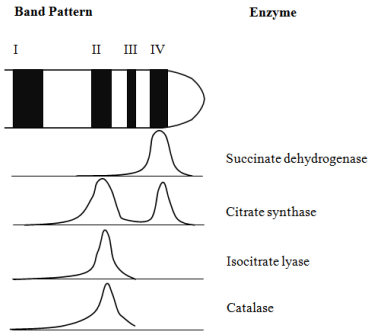
In an experiment, endosperm of 5-day germinating seeds of Ricinus communis (castor bean seeds) were homogenized in an isotonic medium (0.4 moles/lit sucrose). The resulting organelle suspension was layered onto a density gradient column and centrifuged for 4 hrs at 1,00,000 g. Organelles move into the gradient until they have reached a position equivalent to their own density. Determination of protein contents revealed 4 distinct bands (I-IV) along the gradient. Some marker enzymes in each of these bands when tested showed following results:
Bands I-IV represent (Options: Nuclei, Protoplastids, Mitochondria, Cytosol, Microbodies): Band I: _________Band II: _________Band III: _________Band IV: _________
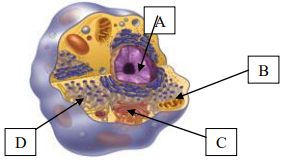
You are a scientist hunting for enzymes involved in various aspects of cellular metabolisms. Which organelle would you want to isolate and analyze if you are looking for: (use the labels of the picture to answer the questions below)
I. Enzyme that is involved in DNA replication ________II. Enzyme involved in producing large amounts of ATP _______III. Enzyme attaching sugar molecules to proteins _________IV. DNA ________
Practice Problems
1. A newly isolated microorganism is found to have a single circular chromosome, no membrane-bound organelles, and 70S ribosomes, but is unusually large (15 μm) for a prokaryote. Would you still classify it as prokaryotic? Justify your answer using the diagnostic features that actually define the category.
Show answer
Yes, classification as prokaryotic vs. eukaryotic is based on the presence/absence of a membrane-bound nucleus and organelles, genome organisation, and ribosome type, not on cell size alone. Size varies substantially within both categories (some prokaryotes, e.g. certain sulfur bacteria, are unusually large), so an atypically large cell that otherwise has every diagnostic prokaryotic feature (no nucleus, no membrane-bound organelles, 70S ribosomes, circular chromosome) is still correctly classified as prokaryotic.
2. Explain, in terms of surface-area-to-volume ratio, why prokaryotic cells are generally under stronger evolutionary pressure to stay small than eukaryotic cells are.
3. A student claims “eukaryotic cells are more evolutionarily advanced than prokaryotic cells.” Identify what is misleading about this framing, using at least one specific counter-example of prokaryotic capability that eukaryotes generally lack.