Q32 - Water-Absorbing Trichomes in Tank Bromeliads
Some plants in the Bromeliaceae essentially lack stems and absorptive roots. They take up water from reservoirs known as “tanks” that are formed by overlaps of bases of different leaves (Fig. P-Q). All Bromeliads have profuse trichome coatings on both sides of their leaves. The coatings consist of tiny sliver white cells that are able to take up moisture and nutrients and transfer these into the plant. Morphology and anatomy of leaf of a bromeliad is shown. The leaf was cut at the base of the tank region, sealed, and immersed in aqueous solution of a fluorescent dye, for 2 h. Cross-sections were made from the blade (Fig. R) and tank (Fig. S) before and after staining, respectively. Red line indicates pathway for water between vein and trichome (tri).
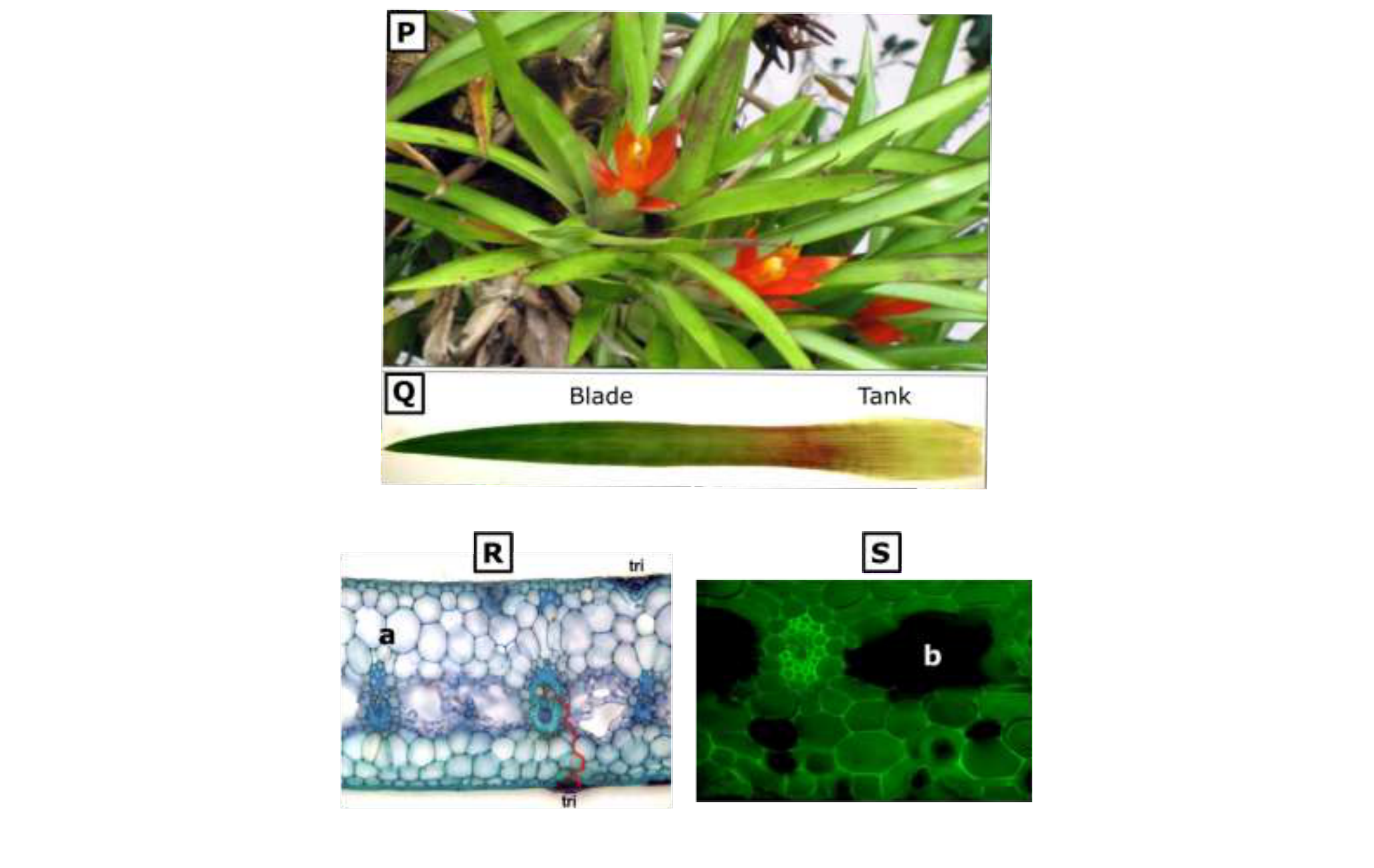 Figure 1.
Using the information and data, determine which of the statements are true or which are false.
Question reproduced from IBO 2018, Theoretical Paper 2, licensed under CC BY-NC-SA 4.0 - attributed to the International Biology Olympiad. Open the full exam PDF · Community solutions (unofficial)