Q4 - Gasdermin D and Pyroptosis
Inflammatory caspases such as caspase 1 are activated in response to microbial infection and stress signals. When activated, they cleave human gasdermin D (GSDMD) after Asp275, to generate an N- terminal cleavage product (GSDMD-NT) and a C-terminal fragment (GSDMD-CT). GSDMD-NT kills bacteria and induces a form of programmed cell death called pyroptosis in human cells. The details of the mechanism by which GSDMD-NT causes cell death are unknown. Mutation of two evolutionarily conserved positively charged residues to alanine produces a mutant form of the protein known as GSDMD-NT 2A, and mutation of four conserved positively charged residues to alanine produces GSDMD-NT 4A. Fig. 1 shows result of non-reducing gel electrophoresis of equal amounts of N-terminal cleavage product of the wild type and mutated forms of GSDMD. In an experiment, E. coli and Staphylococcus aureus bacteria were exposed to nanomolar concentrations of recombinant forms of GSDMD, GSDMD-NT, GSDMD-CT, GSDMD-NT 4A and granulysin (a known cytotoxic lymphocyte pore-forming protein) and the antibacterial effect of these molecules was assessed by measuring reduction of colony formation (Colony Forming Unit, CFU) (Fig. 2). Other experiments showed the same relative effects of the wild type and mutant forms on pyroptosis in human cells.
 Figure 1.
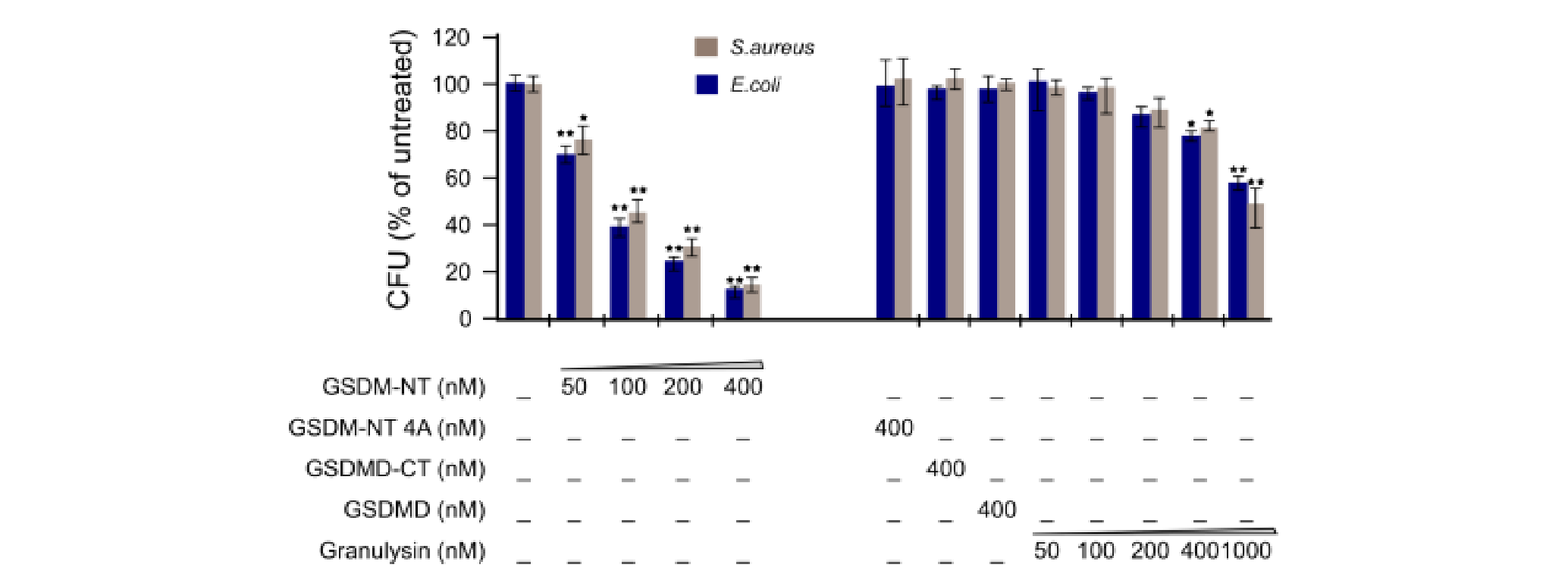 Figure 2.
Using the information and data, determine which of the statements are true or which are false.
Question reproduced from IBO 2018, Theoretical Paper 2, licensed under CC BY-NC-SA 4.0 - attributed to the International Biology Olympiad. Open the full exam PDF · Community solutions (unofficial)