Two families of transcription factors, GNC and GLK, have been implicated in regulating chloroplast development. The promoters which these transcription factors bind to were identified. These promoters were grouped according to whether the genes were upregulated, or downregulated, when these transcription factors were overexpressed (colour of bar). The percentage of these promoters which contained certain hexamer or octamer sequences was plotted (height of bar). The asterisks indicate significant difference compared to the control.
Fig.1. Axis = % of promoters. Legend 1 = Up-regulated by 35S:GNC. Legend 2 = Down-regulated by 35S:GNC. Legend 3 = Control. Legend 4 = Up-regulated by GLK. Legend 5 = Control.
Q20.1. GNC and GLK are transcription factor families implicated in chloroplast development. The nucleotide frequency at each position of the sequences most strongly bound by GNC is plotted (Fig.2, stacked bars showing G/A/T/C proportion at 6 positions). Determine the best-estimate consensus sequence GNC most prefers to bind.
GGGATC: Taking the tallest (most frequent) base at each of the 6 positions from Fig.2: position 1 is dominated by G (~40%), position 2 by G (~39%), position 3 overwhelmingly by G (~50%), position 4 by A (~40%), position 5 by T (~60%), and position 6 by C (~50%), reading those six dominant bases in order gives the consensus GGGATC.
Q20.2 (GNC). Promoters bound by GNC/GLK were grouped by whether the bound gene was up- or down-regulated when that transcription factor was overexpressed (Fig.1). Based on which direction each factor's binding is associated with, is GNC best classified as an activator or a repressor of the genes it binds?
Q20.2 (GLK). Is GLK best classified as an activator or a repressor of the genes it binds?
Q20.3 (GNC). Among the high-affinity binding sites investigated in Fig.1, which ones are NOT specifically active (i.e. don't actually modulate gene expression) for GNC? Write the binding site sequence(s).
GCGATC and CCGATC: These two sequences are high-affinity GNC-binding motifs per Fig.1, but per the official key they don't show a significant up- or down-regulation signature of their own, i.e. GNC can bind them without that binding translating into a real change in the target gene's expression, distinguishing "binds" from "functionally active."
Q20.3 (GLK). Which high-affinity binding site sequence(s) are NOT specifically active for GLK?
RGATTCC and GATTCC (R = A or G): Same logic as GNC's case, these are sequences GLK binds with high affinity per Fig.1, but without a corresponding significant change in expression of the associated genes, per the official key.
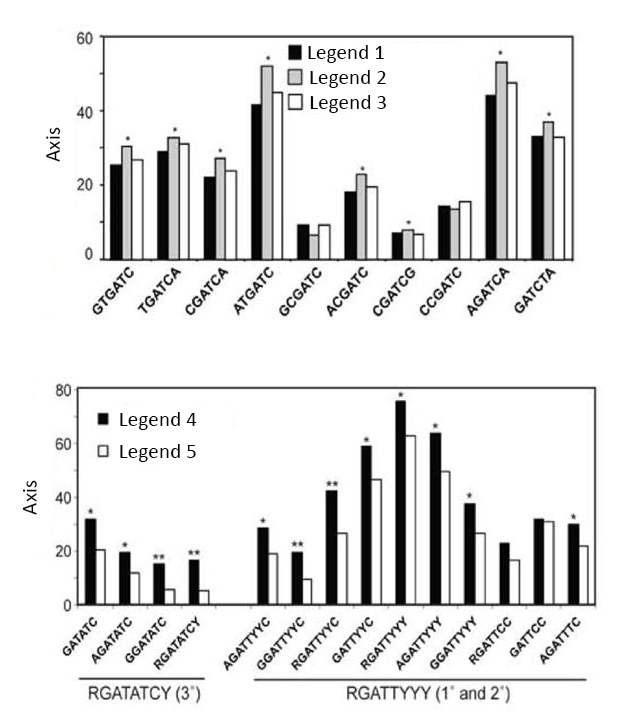 Fig.1. Axis = % of promoters. Legend 1 = Up-regulated by 35S:GNC. Legend 2 = Down-regulated by 35S:GNC. Legend 3 = Control. Legend 4 = Up-regulated by GLK. Legend 5 = Control.
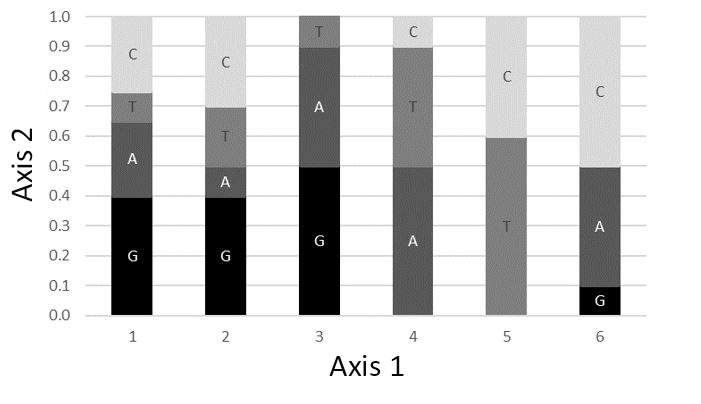 Fig.2. Axis 1 = Nucleotide position. Axis 2 = Nucleotide frequency.