The effect of drought on leaf anatomy was investigated in two types of Olive: Chemlali and Meski. Data is shown in the tables below.
Table 1. r = Thickness (µm), UE = Upper epidermis, SP = Spongy parenchyma, LE = Lower epidermis, TL = Trichome layer, WW = well-watered, UW = under-watered, LA = leaf area, D = density of leaf tissue, S = succulence, CULT = Cultivar × watering regime. Asterisks () indicate significant differences.*
Calculate “A” and “B” in the following table by quantifying the effect of under-watering (UW) relative to the well-watered (WW) condition on spongy parenchyma, as has been done for the effect on upper epidermis (Chemlali UE = 132, i.e. UW expressed as a percentage of WW).
What are the consequences of the following changes? Assign the correct physiological consequence from the list below (A-F) to each of the anatomical changes listed. In some cases you may need more than one letter.
A. Increase in CO2 fixation rate
B. Decrease in CO2 fixation rate
C. Increased transpiration rate
D. Decreased transpiration rate
E. Increased CO2 conductance of leaves
F. Decreased CO2 conductance of leaves
Q21.1 ("A"). The effect of drought was investigated in two olive cultivars (Chemlali, Meski), comparing well-watered (WW) vs. under-watered (UW) leaf tissue thickness. The worked example expresses upper-epidermis (UE) thickness as UW's value relative to WW, as a percentage: Chemlali UE = 132 (i.e. 23.8/18.0 × 100 ≈ 132). Using the same method, calculate "A", spongy parenchyma (SP) thickness for Chemlali (WW = 196.3 µm, UW = 215.7 µm) expressed the same way.
Q21.1 ("B"). Calculate "B", spongy parenchyma (SP) thickness for Meski (WW = 224.9 µm, UW = 234.8 µm), expressed the same way.
Q21.2. What is the physiological consequence of increased upper and lower epidermis thickness? (A: increased CO2 fixation, B: decreased CO2 fixation, C: increased transpiration, D: decreased transpiration, E: increased CO2 conductance, F: decreased CO2 conductance)
Q21.3. What is the physiological consequence of increased upper palisade thickness?
Q21.4. What are the physiological consequences of increased spongy parenchyma thickness? (Select all that apply from: A: increased CO2 fixation, B: decreased CO2 fixation, C: increased transpiration, D: decreased transpiration, E: increased CO2 conductance, F: decreased CO2 conductance.)
A and E: Spongy parenchyma's loosely-packed cells with large air spaces maximise the internal surface area available for gas exchange, more of it increases both CO2 conductance into the leaf (E) and, since that CO2 reaches photosynthetic tissue more easily, CO2 fixation rate (A).
Q21.5. What is the physiological consequence of increased trichome density?
Q21.6. What are the physiological consequences of increased leaf area? (Select all that apply, same A-F options as above.)
A and C: A bigger leaf has more total photosynthetic surface (more total CO2 fixation, A) but also more total surface for water vapour to escape from (more total transpiration, C), both scale up together with leaf area, unlike the anatomical (per-unit-area) changes in the other rows.
Q21.7. What is the physiological consequence of increased succulence?
Q21.8. Determine the difference in drought resistance between the two cultivars: Resistance of Chemlali (A) __ Resistance of Meski (B)?
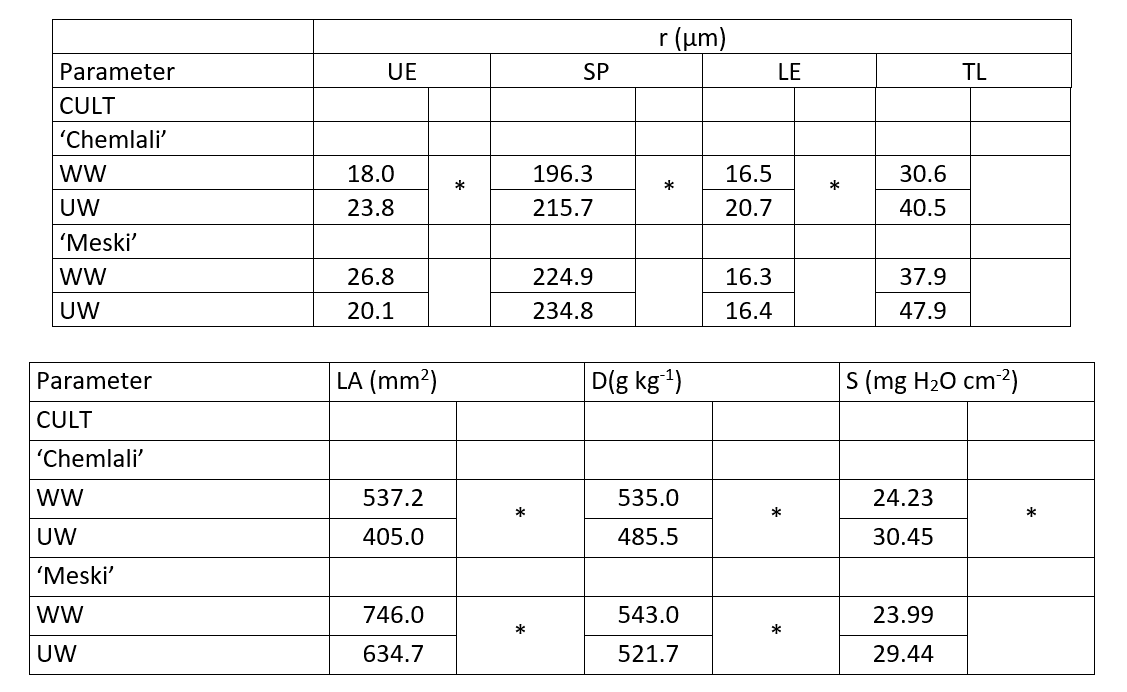 Table 1. r = Thickness (µm), UE = Upper epidermis, SP = Spongy parenchyma, LE = Lower epidermis, TL = Trichome layer, WW = well-watered, UW = under-watered, LA = leaf area, D = density of leaf tissue, S = succulence, CULT = Cultivar × watering regime. Asterisks () indicate significant differences.*