Q23 - Statoliths and Root Geotropism in Microgravity
Statocytes are cells in the central root cap thought to be crucial in geotropism of the plant root. These cells possess starch-filled granules, statoliths, which have a higher density than the statocyte cytoplasm, so their position in the statocyte depends on the root’s orientation relative to the direction of the gravitational force it experiences.
In order to determine the role of statoliths in geotropism and their mechanism of action, Brassica napus seeds were taken to and grown on the International Space Station. Seedlings were grown either in a centrifuge that exerts 1g force (fig A) or in microgravity (negligibly small gravity, fig B). Root tissues were fixed after 40 hours of germination and statolith position determined, represented in a unified coordinate system whose origin (0;0) is the centre of the statocyte.
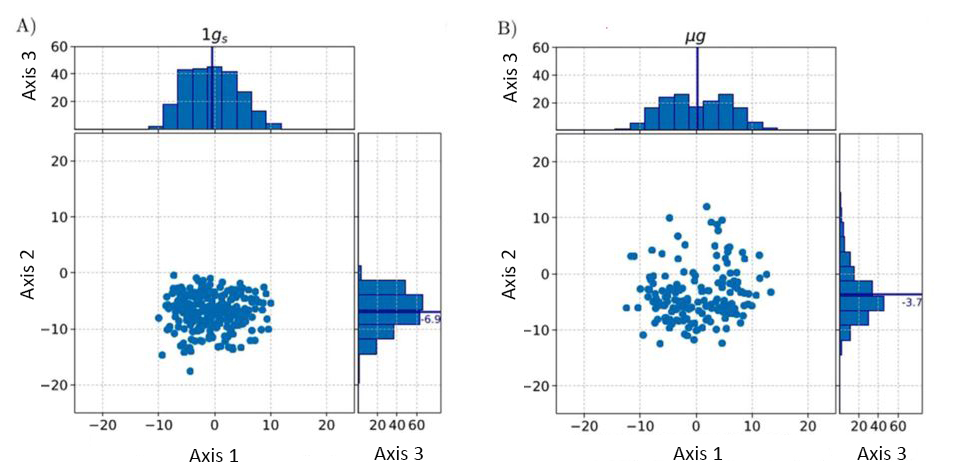 Fig.1. Axis 1 = Statocyte transverse position (µm). Axis 2 = Statocyte longitudinal position (µm). Axis 3 = Count.
Each tile below represents the final growth direction of a root tip relative to the direction of gravity (arrow). Determine which of the diagrams depict the distribution of growing root tips in microgravity and in 1g gravitational force - there are two correct answers for each condition.
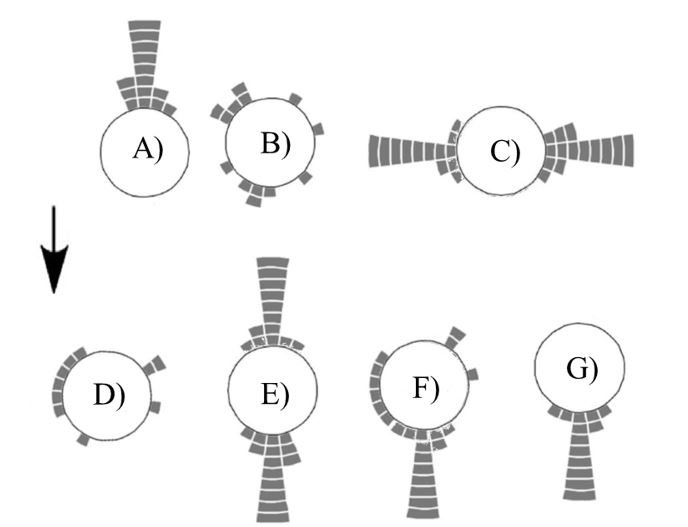 Fig.2.
Assume statocytes are cylindrical. Statoliths can move freely across the diameter of the statocyte, but can only move 40% of the statocyte’s length. Estimate the approximate diameter and length of a statocyte, in µm.
Question reproduced from IBO 2019, Theoretical Exam A, licensed under CC BY-NC-SA 4.0 - attributed to the International Biology Olympiad. Open the full exam PDF · Official answer key