Q24 - Nitric Oxide and Guard Cell K+ Currents
Electrophysiological measurements were carried out on bean guard cells to measure outward K+ currents and how they are modified by various factors. Assume the K+ currents shown are proportional to net changes in intracellular K+ concentration. Currents (I) across the plasma membrane at different voltages (V) were determined after each step of four different experiments:
Experiment 1 - Step 1: incubated in washing buffer. Step 2: exposed to exogenous nitric oxide (NO). Step 3: washed in washing buffer.
Experiment 2 - Step 1: injected with buffer to set cytoplasmic pH to 7.4. Step 2: exposed to exogenous NO. Step 3: washed in washing buffer.
Experiment 3 - Step 1: incubated in washing buffer. Step 2: exposed to exogenous NO. Step 3: exposed to BAL, a reducing agent known to reduce disulphide bridges in proteins. Step 4: exposed to exogenous NO again.
Experiment 4 - Step 1: incubated in washing buffer. Step 2: exposed to PAO, an oxidising agent that localises to membranes within the cell. Step 3: washed in washing buffer containing 0.3mM BAL.
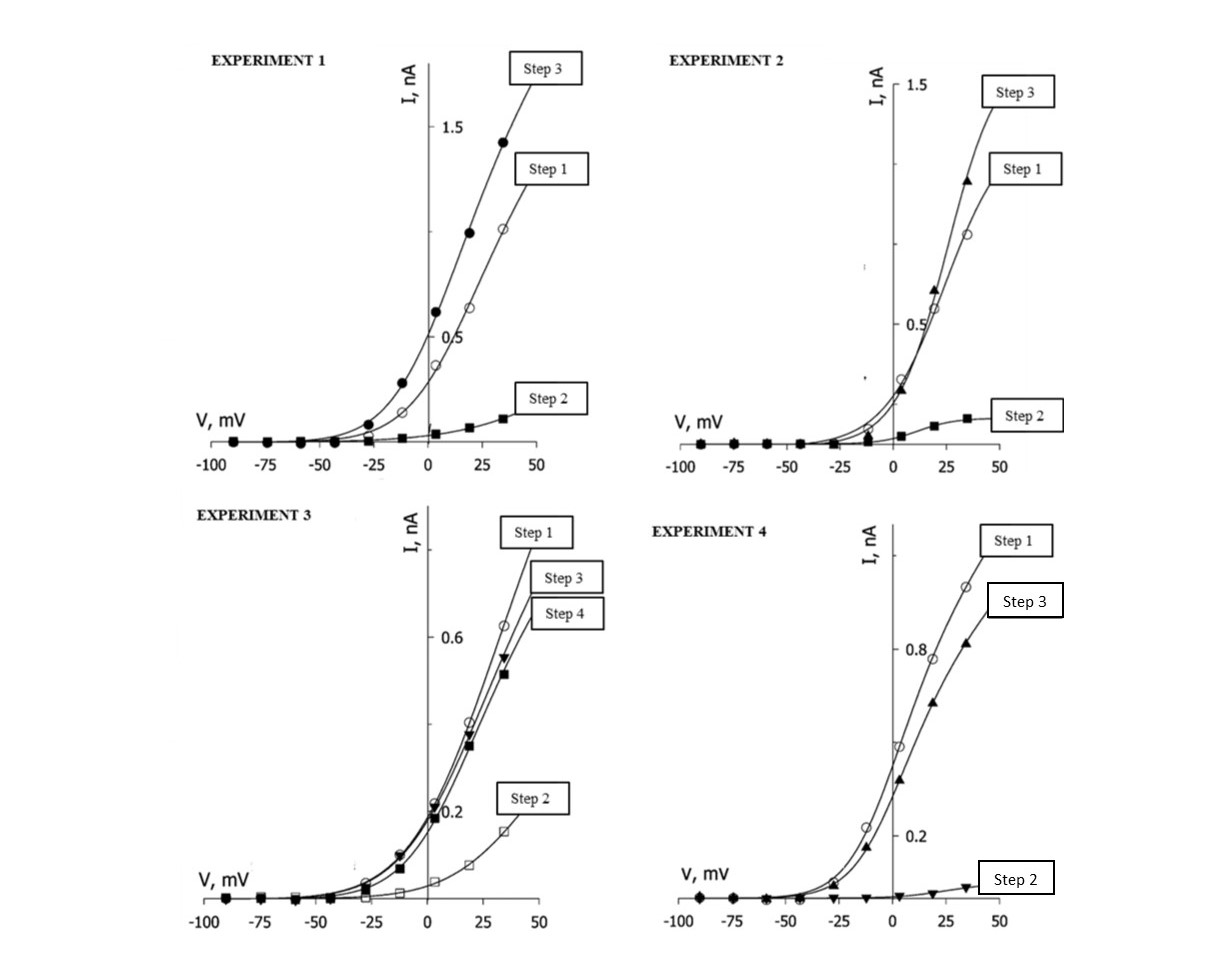 Fig.1.
Based on the information above, indicate with an X if each of the following statements is true (T) or false (F).
Question reproduced from IBO 2019, Theoretical Exam A, licensed under CC BY-NC-SA 4.0 - attributed to the International Biology Olympiad. Open the full exam PDF · Official answer key