In this task you get a few parts of a phylogenetic tree of birds, and you should assemble the full tree based on them.
Fig.1.
The species to place in the full phylogenetic tree, indicated by letters:
A – A. cinerea
B – A. crecca
C – C. crex
D – C. monedula
E – L. argentatus
F – P. carbo
G – P. cristatus
H – S. borin
I – T. pilaris
J – T. totanus
You should find the place of each species in the tree below. Match the letter of the species (A-J) with the Roman numerals (I.-VII.) of the positions in the tree. One numeral can belong to more than one letter.
Fig.2. Target skeleton tree with positions I–VII to be filled in with species letters A–J.
Indicate your answer by putting an X in the appropriate box on the answer sheet.
Q34.1. Given four overlapping partial phylogenetic trees (each showing 5 of 10 bird species: A-A. cinerea, B-A. crecca, C-C. crex, D-C. monedula, E-L. argentatus, F-P. carbo, G-P. cristatus, H-S. borin, I-T. pilaris, J-T. totanus), assemble the full consensus tree and match each species letter to its position (Roman numeral I-VII) in the skeleton tree. Where does species A (A. cinerea) belong?
Q34.2. Where does species B (A. crecca) belong?
Q34.3. Where does species C (C. crex) belong?
Q34.4. Where does species D (C. monedula) belong?
Q34.5. Where does species E (L. argentatus) belong?
Q34.6. Where does species F (P. carbo) belong?
Q34.7. Where does species G (P. cristatus) belong?
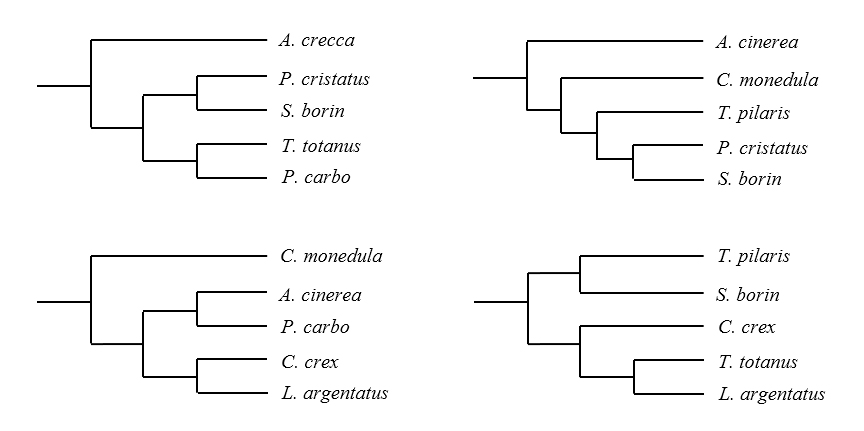 Fig.1.
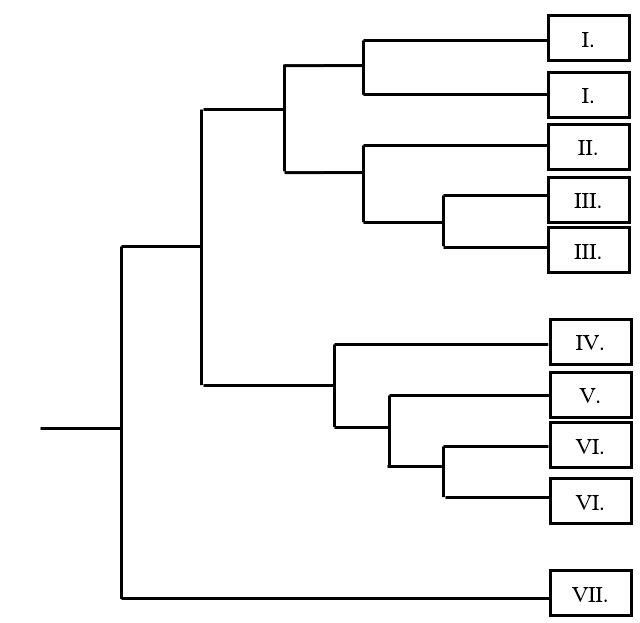 Fig.2. Target skeleton tree with positions I–VII to be filled in with species letters A–J.