Skip to content
← Theoretical A

Q35 - A New Gall Wasp Genus: Molecular Systematics

Theoretical A Real exam question - full text reproduced under IBO's CC BY-NC-SA 4.0 license

A research group collected and examined gall wasp (Cynipidae) specimens. By examining morphological traits, they found a new genus (Lithosaphonecrus) with four species (L. formosanus, L. huisuni, L. dakengi, and L. yunnani). To confirm these results and determine their phylogenetic relationship to other closely related gall wasp species, they compared the sequence of two DNA fragments (COI and 28S D2) of each species and calculated the pairwise distance (p-distance) between each species. The p-distance of two species is the number of nucleotide sites at which homologous sequences of the two species differ, divided by the total number of nucleotides compared.
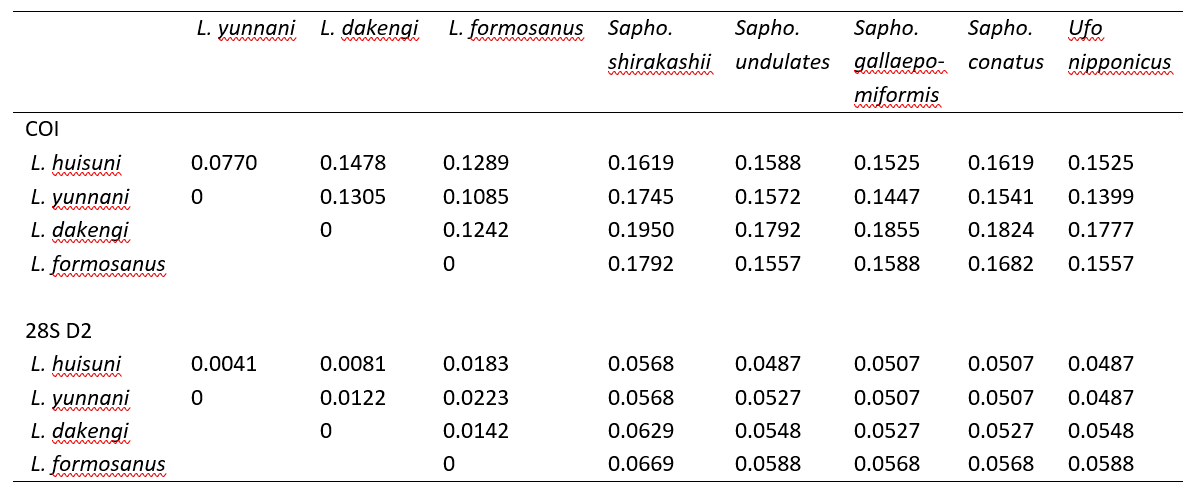
A p-distance matrix table with two sections (COI and 28S D2), each comparing L. huisuni, L. yunnani, L. dakengi, and L. formosanus against each other and against four other related gall wasp species/genera (Sapho. shirakashii, Sapho. undulates, Sapho. gallaepomiformis, Sapho. conatus, Ufo nipponicus). Within the four Lithosaphonecrus species, the smallest p-distance in both COI (0.0770) and 28S D2 (0.0041) is between L. huisuni and L. yunnani; all four species have p-distances of 0.10-0.20 (COI) and 0.004-0.02 (28S D2) to each other, versus much larger, roughly-uniform distances (0.14-0.20 COI, 0.05-0.07 28S D2) to all of the outgroup species/genera. Table 1. p-distances among the two sequences (COI and 28S D2) of the species.

Indicate with an X if each of the following statements is true (T) or false (F).

Q35.1. A new gall wasp genus (Lithosaphonecrus) with 4 species was compared via COI and 28S D2 pairwise sequence distances (p-distance = fraction of differing nucleotide sites). L. huisuni and L. yunnani are the two most closely related species in the genus.
Q35.2. Phylogenetically, Ufo nipponicus is more closely related to L. yunnani than to L. dakengi.
Q35.3. The differences between the results obtained for the two sequences (COI and 28S D2) mean an error occurred during sequencing.
Q35.4. The COI region is more useful for research into phylogenetic relationships between more distantly related species than 28S D2.

Question reproduced from IBO 2019, Theoretical Exam A, licensed under CC BY-NC-SA 4.0 - attributed to the International Biology Olympiad. Open the full exam PDF · Official answer key