Q18 - Transcriptional Attenuation of the E. coli trp Operon
The tryptophan operon (trp operon) of E. coli is transcriptionally regulated by a repressor that is activated by the binding of tryptophan. The active form repressor binds to the operator sequence located between the promoter and the transcription initiating point and blocks the RNA polymerase. There is another expression control system called the attenuator linked to transcription and translation in the trp operon. Between the operator sequence and the trpE gene, which is the first structural gene of the trp operon, there are four sequences of about 15 bases called Region 1-4 (Figure 1). Region 1 and Region 2, and Region 3 and Region 4 have complementary sequences, respectively. When these regions are transcribed as mRNA, they are paired with each other and form stem-loop structures (Figure 2). Furthermore, the sequences of Region 2 and Region 3 are also complementary, so a stem loop structure can be formed. A short peptide of 14 amino acids containing two tryptophan codons called a leader peptide is encoded in Region 1 (Figure 1). If the trp operon mRNA is not translated at the same time as it is transcribed by RNA polymerase, Region 1 and Region 2 of mRNA, and Region 3 and Region 4 pair with each other to form stem loop structures, respectively. In this case, a consecutive U bases is located immediately after Region 4. Since the form in which U bases continue immediately after the stem loop structure functions as a transcription termination signal in the procaryote, the RNA polymerase is released and the transcription is terminated (Figure 2). When the translation of the leader sequence occurs at the same time as the transcription of the mRNA, the ribosome can translate the mRNA with the stem loop structure, but the transcription also ends by forming the stem loop structure of Region 3 and Region 4. When tryptophan is deficient, it takes time to translate the Trp codons in the leader sequence, and the ribosome temporarily stays in Region 1. The mRNA transcribed during that time will be paired with Region 2 and Region 3 to form a stem loop structure. In this case, since Region 4 does not pair, a transcription termination signal is not formed, and RNA polymerase continues transcription of the trpEDCBA operon encoding the downstream Trp biosynthetic enzymes (Figure 3).
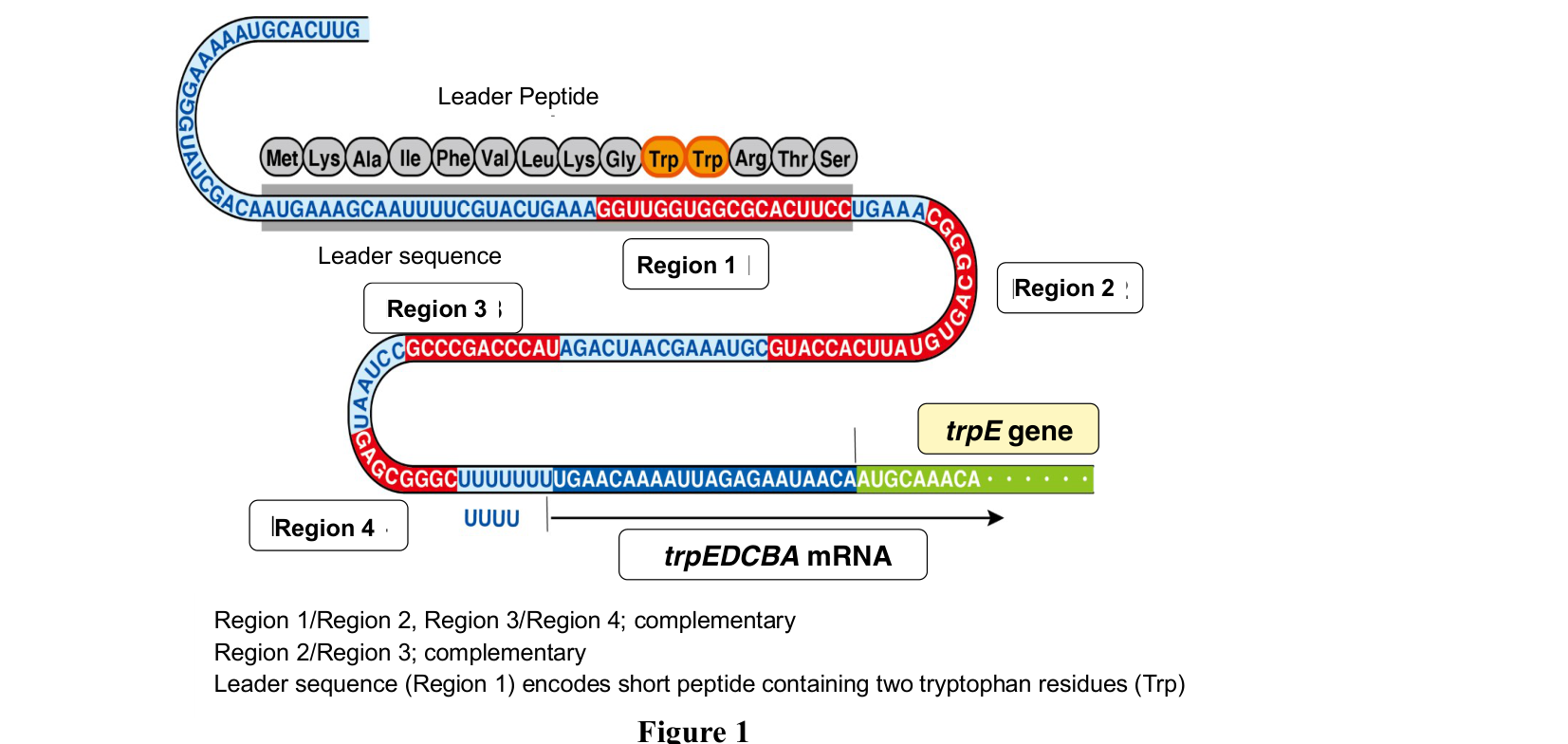 Figure 1.
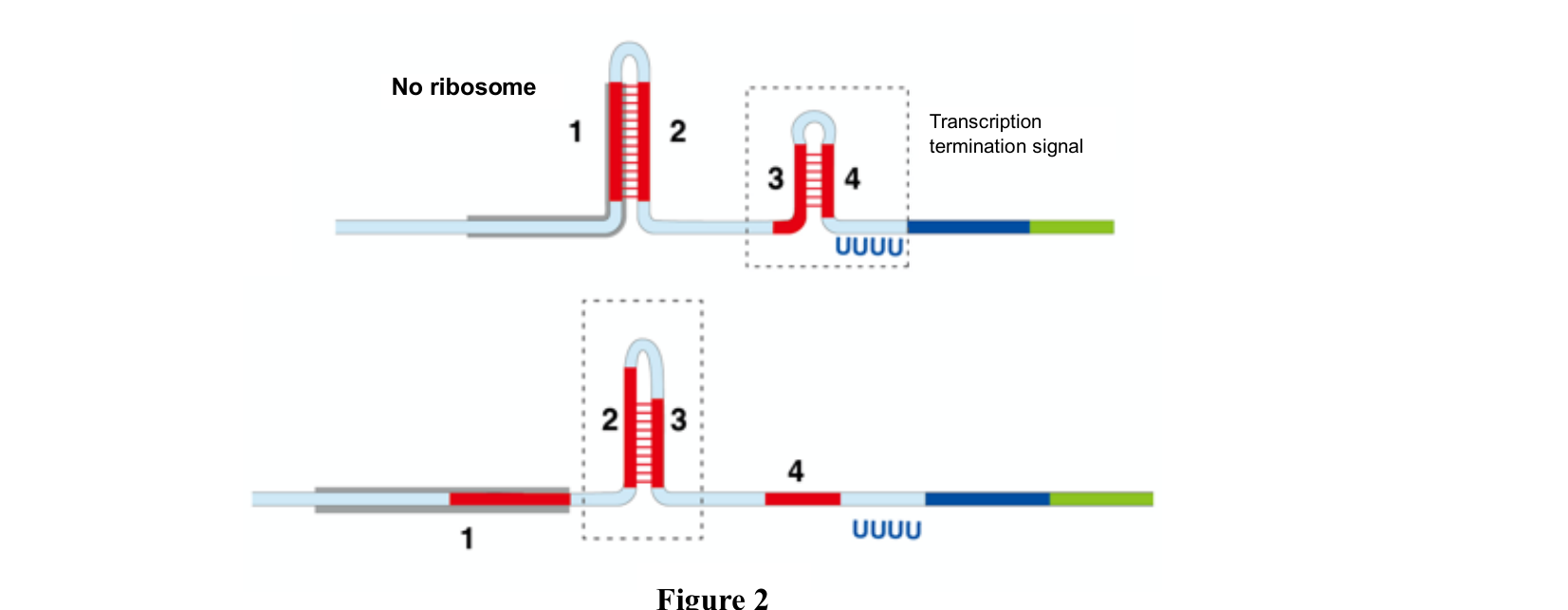 Figure 2.
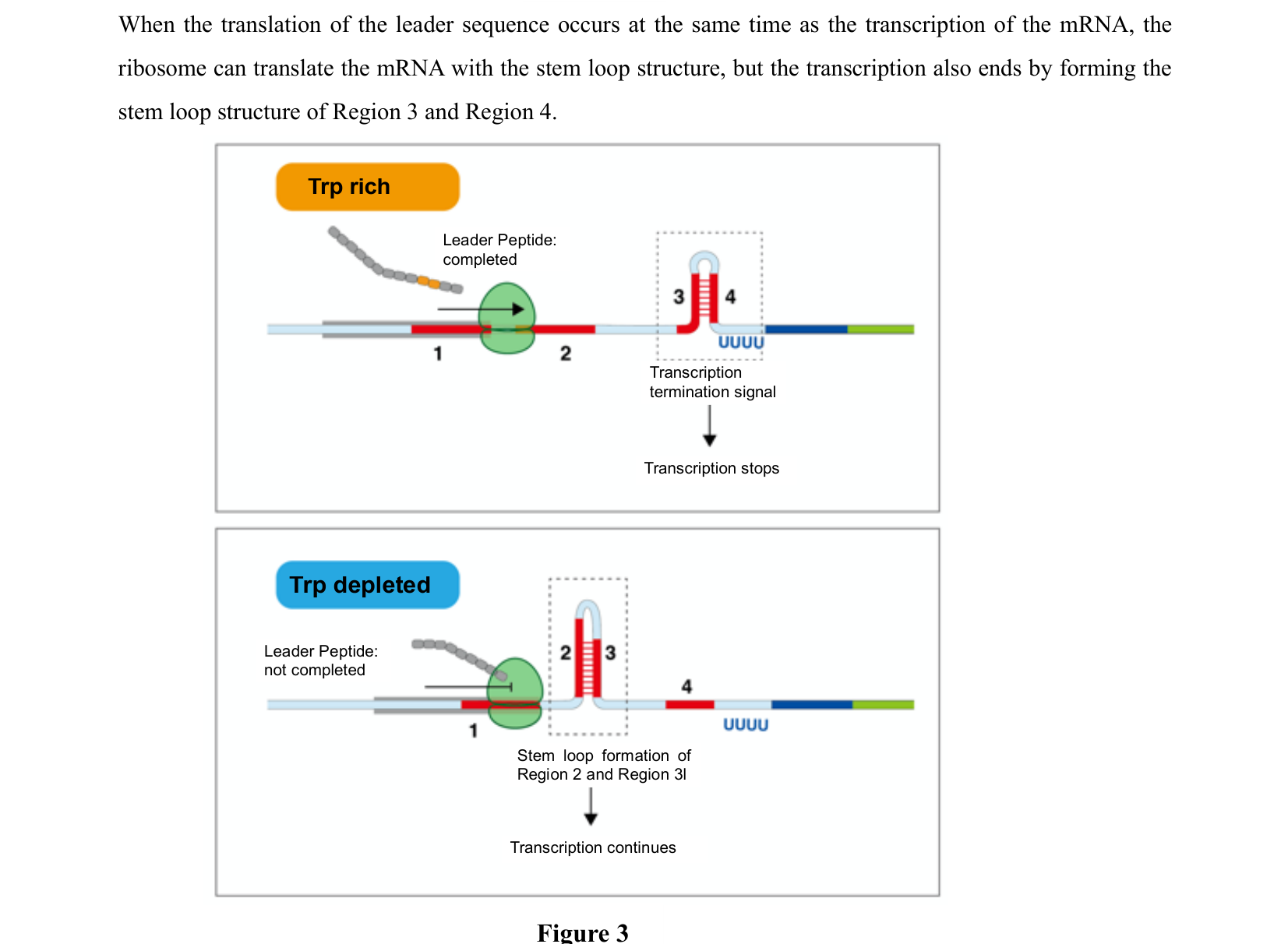 Figure 3.
Using the information and data, determine which of the statements are true or which are false.
Question reproduced from IBO 2020, Theoretical Exam 1, licensed under CC BY-NC-SA 4.0 - attributed to the International Biology Olympiad. Open the full exam PDF · Community solutions (unofficial)