Gene Regulation: Prokaryotic
Overview
Bacteria regulate gene expression almost entirely at the level of transcription initiation, using a compact and efficient organisational unit, the operon, that groups functionally related genes under shared regulatory control. This page covers the operon model through its two classic case studies (lac and trp), which illustrate contrasting regulatory logic (inducible vs. repressible, negative vs. positive control), plus two additional layers of prokaryotic regulation below the level of transcription initiation itself.
Key Concepts
The operon: shared regulation for functionally linked genes
An operon is a cluster of genes transcribed together as a single polycistronic mRNA (one transcript encoding multiple proteins), under the control of one shared promoter and (usually) one or more operator sequences: regulatory DNA sites where a repressor protein can bind to block transcription. Grouping functionally related genes (e.g. all enzymes of one metabolic pathway) under shared control lets the cell switch the entire pathway on or off with a single regulatory event, rather than independently regulating each gene.
The lac operon: inducible, negative control
The lac operon encodes enzymes for lactose metabolism (including β-galactosidase, which cleaves lactose). In the absence of lactose, the lac repressor protein binds the operator, physically blocking RNA polymerase from transcribing the operon: the default state is off. When lactose is present, a lactose metabolite (allolactose) binds the repressor, causing a conformational change that releases it from the operator, allowing transcription to proceed: the operon is induced by the presence of its substrate. This is negative control: the regulatory protein (repressor) actively represses transcription in the absence of the appropriate signal, and its removal permits transcription.
The lac operon also integrates a second, independent layer of regulation reflecting overall cell energy status: when glucose (the preferred carbon source) is scarce, cAMP levels rise, and cAMP-bound CAP (catabolite activator protein) binds a separate site near the promoter, enhancing RNA polymerase binding: this is positive control, since CAP actively promotes rather than merely permits transcription. Full lac operon expression therefore requires both conditions simultaneously: lactose present (repressor released) and glucose absent (CAP active), a classic example of combinatorial (AND-gate-like) regulatory logic ensuring the cell only invests in lactose metabolism when lactose is available and glucose (the more efficient preferred fuel) is not.

The trp operon: repressible, negative control
The trp operon encodes enzymes for tryptophan biosynthesis: the opposite metabolic direction from lac’s catabolic (breakdown) role, and correspondingly opposite regulatory logic. In the absence of tryptophan, the trp repressor is inactive and unable to bind the operator, so the operon is transcribed by default (on): the cell synthesises tryptophan because it needs to. When tryptophan is abundant, it acts as a co-repressor, binding the trp repressor and activating it, allowing it to bind the operator and shut transcription off: the cell stops making an amino acid it no longer needs to synthesise. This is still negative control (a repressor blocks transcription), but the operon’s default state and its response to the regulatory molecule are inverted relative to lac, worth stating explicitly, since this contrast (inducible/catabolic vs. repressible/biosynthetic) is the single most common comparative exam framing for this topic.
![trp operon regulatory region: inactive trp repressor cannot bind DNA alone, but binding tryptophan activates it (high [Trp]: repression occurs) to bind the operator and block transcription; the operon layout shows promoter (P), operator (O), leader (trpL) with its attenuator, and the five structural genes trpE-trpD-trpC-trpB-trpA, with high Trp producing only an attenuated mRNA and low Trp producing the full trp mRNA](/MCBBPICS/trp-operon-active-repressed.png) Source: en.wikipedia.org (Trp operon)
Source: en.wikipedia.org (Trp operon)
Attenuation: a second, finer regulatory layer on the trp operon
Beyond repressor-mediated on/off control, the trp operon carries an additional regulatory mechanism unique to bacteria’s lack of a nuclear envelope: attenuation, which fine-tunes transcription after it has already begun, exploiting the fact that transcription and translation are physically coupled in bacteria (a ribosome can begin translating an mRNA while RNA polymerase is still transcribing further downstream, impossible in eukaryotes, where transcription and translation are separated by the nuclear envelope, see Transcription & RNA Processing). A leader sequence upstream of the trp structural genes encodes a short peptide containing two consecutive tryptophan codons; when Trp is scarce, the ribosome stalls at these codons (waiting for scarce charged Trp-tRNA), and this stalling alters the folding of the nascent mRNA in a way that permits RNA polymerase to continue transcribing; when Trp is abundant, the ribosome translates through smoothly without stalling, and the resulting alternative mRNA fold instead forms a terminator hairpin, prematurely halting transcription. Attenuation thus provides graded, rapid, translation-coupled fine-tuning layered directly on top of the coarser repressor-based on/off switch.

Riboswitches: regulation without any protein at all
Riboswitches are regulatory RNA elements, typically located in an mRNA’s 5′ untranslated region, that directly bind a small metabolite ligand (no protein intermediary required), ligand binding changes the RNA’s secondary structure, which in turn affects either transcription termination or translation initiation. Riboswitches represent regulation occurring entirely at the RNA level, and are considered strong supporting evidence for the “RNA world” hypothesis of early evolution, since they demonstrate RNA’s independent capacity for both ligand recognition and structural regulatory switching, without requiring any protein component.
Comparative Structures
| Feature | lac operon | trp operon |
|---|---|---|
| Metabolic direction | Catabolic (breakdown) | Biosynthetic (synthesis) |
| Default state (no regulatory molecule) | Off (repressor bound) | On (repressor inactive) |
| Effect of regulatory molecule (lactose/tryptophan) | Induces (turns on) | Represses (turns off) |
| Control type | Negative (repressor) + positive (CAP) | Negative (repressor) only, plus attenuation |
| Regulatory molecule role | Inducer (releases repressor) | Co-repressor (activates repressor) |
Common Exam Questions
- “Compare the regulatory logic of the lac and trp operons”: the expected answer contrasts catabolic/inducible vs. biosynthetic/repressible directly, and correctly identifies that both use negative control (via a repressor) despite having opposite default states and opposite responses to their regulatory molecule.
- “Why does the lac operon require both lactose presence and glucose absence for full expression?”, tests understanding of the combined negative (repressor/lactose) and positive (CAP/cAMP/glucose) control layers operating together.
- “How is attenuation possible in bacteria but not eukaryotes?”: the correct answer must cite the physical coupling of transcription and translation in bacteria (no nuclear envelope separating them), which is structurally impossible in eukaryotes.
- Riboswitch questions often test recognition that regulation is occurring with no protein involved at all, a frequently missed detail when a question describes a metabolite directly altering an mRNA’s own structure.
Visual Reference
Interactive
- A lac operon state simulator: toggle lactose and glucose presence/absence independently and see the repressor/CAP binding states and resulting transcription output (on/off) update live, directly visualises the AND-gate combinatorial logic.
Static
(Static images are placed inline in Key Concepts above, next to the concept each one illustrates, rather than collected here.)
Practice Challenge
Competition-sourced practice questions for this topic, graded by difficulty. Click the Solution tab to reveal each answer.
If the operator region of lac operon in E. coli is replaced with that of operator from trp operon, predict what will happen to the expression of lac operon genes in the medium that contains:
A. Only Glucose, no lactose, no tryptophanB . No glucose, no lactose, only tryptophanC . No glucose, no tryptophan, only lactoseD . Tryptophan and lactose, no glucoseE . Tryptophan, IPTG (analogue of lactose), no glucose
Indicate whether lac operon will be expressed or will not be expressed by putting tick marks (✔) in the appropriate boxes:
| Medium | A | B | C | D | E |
|---|---|---|---|---|---|
| Expressed | |||||
| Not Expressed |
An E. coli culture was grown under four nutrient conditions, and β-galactosidase activity was measured as an indicator of lac operon transcription:
| Condition | Glucose | Lactose | Observed β-galactosidase activity |
|---|---|---|---|
| A | + | - | Very low |
| B | + | + | Low |
| C | - | - | Very low |
| D | - | + | High |
Which of the following statements most accurately explains the molecular basis for the observed results?
A. The presence of glucose prevents formation of CAP-cAMP complex limiting operon induction even when lactose is available.B . Absence of glucose permits efficient uptake of lactose, but allolactose cannot inactivate the repressor unless cAMP is degraded, hence transcription remains low.C . When both lactose and glucose are absent, the lac operon is repressed solely because CAP- cAMP complex binds strongly to the promoter, preventing RNA polymerase attachment.D . Glucose enhances adenylate cyclase activity, producing high cAMP that represses lac operon transcription until lactose concentration falls below threshold.

The regulatory region of a bacterial gene, called ‘A’, is shown below. The promoter (P) and regulatory region (R) regulate the transcription of the gene. Chemical X regulates the expression of the gene by interacting with a protein Y. There are 3 binding sites (R1, R2, R3) for protein Y in region R. Protein Y has different binding affinities for the 3 sites.
An experiment was carried out to study the role of the 3 binding sites. The binding sites (R1 to R3) were deleted individually, or in combination, and the expression of gene ‘A’ was measured in the presence or absence of chemical X. The table shows the ratio of expression of gene ‘A’ in the presence: absence of chemical X. A cross (×) denotes that the site is deleted, while a tick (✓) denotes the presence of the binding site. In each of the strains below, the expression of gene ‘A’ in the absence of chemical ‘X’ is 15 arbitrary units.
| Strain | R1 | R2 | R3 | Ratio of expression of gene ‘A’ in the presence : absence of chemical ‘X’ |
|---|---|---|---|---|
| WT | ✓ | ✓ | ✓ | 120 |
| M1 | ✓ | ✓ | × | 52 |
| M2 | ✓ | × | ✓ | 3 |
| M3 | × | ✓ | ✓ | 107 |
| M4 | × | ✓ | × | 30 |
| M5 | ✓ | × | × | 1 |
| M6 | × | × | ✓ | 1 |
| M7 | × | × | × | 1 |
Indicate if each of the given statements are True or False:A. If gene Y is deleted, the ratio of activity will increase.
B. The binding affinity of protein Y for R2 site is expected to be the highest.
C. The sequence TGTGA is important for the binding of protein Y to the R sites.
D. The binding of protein Y to R3 and R2 influences the gene activity in the same way as protein Y binding to R1 and R2.
Toehold switches are a class of synthetic RNA regulators that can repress gene expression by sequestering the Ribosome Binding Site (RBS) in a stable hairpin structure. Upon the addition of a small RNA called the toehold trigger, the hairpin structure unfolds, and the RBS is released.
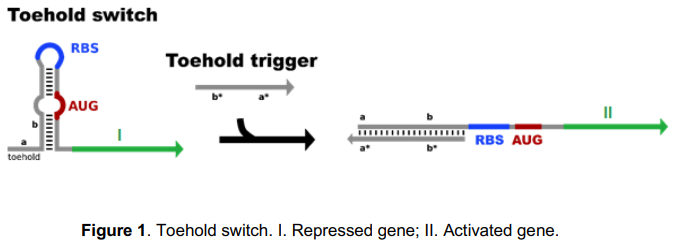
Indicate whether the following statements are true or false:
A. Toehold switches work by repressing the translation of the gene. B. A strong hairpin structure can be made from direct repeats in the RNA sequence. C. The toehold switch will work just as well in eukaryotes as in bacteria. D. One toehold switch can control all genes in an operon.
Practice Problems
1. A bacterial cell is grown in a medium containing abundant glucose and abundant lactose simultaneously. Predict the expression level of the lac operon, and explain using both regulatory layers.
Show answer
Lac operon expression remains low, despite lactose being present. Lactose presence does release the lac repressor from the operator (satisfying the negative-control requirement), but abundant glucose keeps cAMP levels low, so CAP remains largely inactive and fails to enhance RNA polymerase binding at the promoter (the positive-control requirement is not met). Both conditions, inducer present AND CAP active, are required for strong expression; satisfying only one is insufficient for high-level transcription.
2. A mutation eliminates the trp operon’s attenuation mechanism entirely, while the repressor-based on/off control remains fully functional. Predict the effect on the operon’s regulatory behaviour, particularly its sensitivity to intermediate (neither scarce nor abundant) tryptophan levels.
3. Explain why attenuation, as a regulatory mechanism, could not function in a eukaryotic cell even if the exact same leader-sequence/ribosome-stalling logic were somehow present, referencing the physical organisation of eukaryotic transcription and translation.