Q23 - GABA-Induced Chloride Currents and Depolarization in a Hypothalamic Neuron
A researcher recorded neurotransmitter responses from a neurosecretory neuron in the hypothalamus. Gamma- aminobutyric acid (GABA) is well-known as the neurotransmitter at most inhibitory synapses in the brain. The researcher found that the application of GABA to this neuron induced more action potentials (Figure 1). Then, the researcher measured GABA-induced chloride current responses of the neuron under various experimentally controlled membrane potentials (from -50 to 0 mV at 10mV steps; Figure 2). They also plotted maximum current amplitudes (current differences before and after the GABA application) against membrane potentials (Figure 3). A downward deflection of a current trace is referred to as an inward current and reflects the movement of Cl- ions out of the cell (Figure 4). Table 1 shows the intra- and extracellular concentrations and the equilibrium potentials of sodium, potassium, and chloride ions calculated by Nernst’s equation.
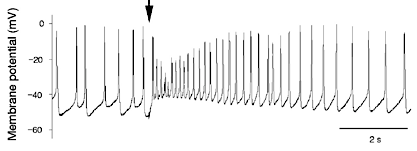 Figure 1.
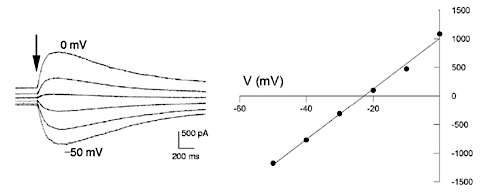 Figure 2.
Using the information and data, determine which of the statements are true or which are false.
Question reproduced from IBO 2020, Theoretical Exam 1, licensed under CC BY-NC-SA 4.0 - attributed to the International Biology Olympiad. Open the full exam PDF · Community solutions (unofficial)