Q29 - Stomatal Aperture Responses to Humidity in Air versus Helox
In order to prevent an excess water loss, stomata respond rapidly to changes in humidity. Transpiration rate per unit leaf area represents the speed of water loss from the plant body. It is proportional to the diffusion rate of water vapor (dwater), the water vapor concentration difference across the leaf epidermis (deltaw), and the relative stomatal aperture. Figure 1 shows relative stomatal apertures in normal air and in Helox air (79:21 mixture of He and O2 with the appropriate concentrations of water vapor and CO2 added). Relative stomatal apertures were measured in normal air (Air) and in Helox air under three different deltaw conditions: the same deltaw as that in normal air (Helox), 2/3 of the normal air deltaw (Helox2/3), and 1/2.33 of the normal air deltaw (Helox1/2.33). dwater in Helox air is 2.33 times higher than that in normal air, while Helox air does not affect any other factors of transpiration. Note that water vapor diffuses only though the stomata and that the water vapor concentration inside the leaf is always saturated.
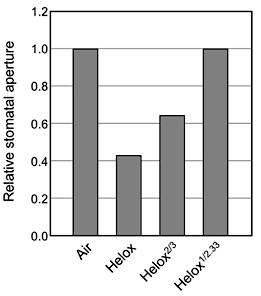 Figure 1.
Using the information and data, determine which of the statements are true or which are false.
Question reproduced from IBO 2020, Theoretical Exam 1, licensed under CC BY-NC-SA 4.0 - attributed to the International Biology Olympiad. Open the full exam PDF · Community solutions (unofficial)