Q34 - Resource Sharing Between Stolon-Connected Ramets of Fragaria chiloensis
Fragaria chiloensis is a stolon-bearing perennial herb that grows on coastal sand dunes. In coastal sand dunes, nitrogen-fixing shrubs often create small patches of lower photon flux density (PFD) but higher soil nitrogen availability. The presence of such patches frequently makes a difference in the resource availability between stolon-connected ramets. To examine effects of stolon connection, researchers compared the growth of connected ramets and severed ramets; one ramet in each pair was provided with high PFD but a low level of soil nitrogen, and the other ramet was provided with low PFD but a high level of soil nitrogen (Figure 1). As a result, combined dry biomass of connected ramets was 54% higher than that of severed ramets. (Stolon: a stem that grows along the soil surface and forms buds and roots at the nodes for clonal propagation. Ramet: an individual unit of a clonal colony.)
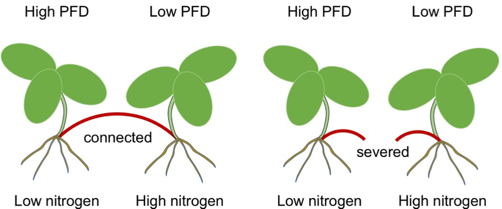 Figure 1.
Using the information and data, determine which of the statements are true or which are false.
Question reproduced from IBO 2020, Theoretical Exam 1, licensed under CC BY-NC-SA 4.0 - attributed to the International Biology Olympiad. Open the full exam PDF · Community solutions (unofficial)