Q33 - A CYCLOIDEA-like Gene Controlling Floral Symmetry in Sunflower
While snapdragon normally has bilateral flowers, flowers of its mutant defective in gene G lose bilateral symmetry and have radial symmetry, thereby indicating that gene G confers bilateral symmetry to the flower. In the inflorescence of wild-type sunflower, the outer region has ligulate florets, whereas the inner region has tubular florets (Figure 1). Variants x, y, and z of sunflower have DNA insertions in gene G’, a sunflower orthologue of the gene G from snapdragon (Figure 2). As a result of these insertions, variant x has only ligulate florets over the entire inflorescence, and variants y and z have only tubular florets over the entire inflorescence. Variant y has two DNA insertions, while variants x and z have one insertion.
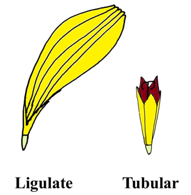 Figure 1.
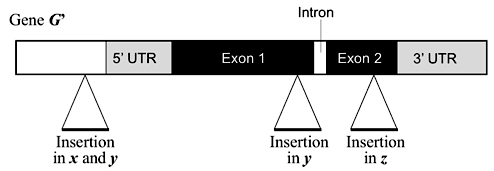 Figure 2.
Using the information and data, determine which of the statements are true or which are false.
Question reproduced from IBO 2020, Theoretical Exam 1, licensed under CC BY-NC-SA 4.0 - attributed to the International Biology Olympiad. Open the full exam PDF · Community solutions (unofficial)