Q35 - Distinguishing Osmotic and Ionic Ca2+ Signaling Mutants in Salt Stress
Soil salinity (NaCl) affects the growth of plants. As the increase of osmotic pressure induced by soil salinity reduces the ability of plants to take up water and minerals, soil salinity elicits osmotic stress. Additionally, because cytosolic Na+ interferes with the activities of metabolic enzymes, soil salinity also elicits ionic stress. Thus, NaCl elicits two primary effects on plant cells, which both trigger a signaling cascade that start with the elevation of the intracellular Ca2+ concentration ([Ca2+]i). In contrast, sorbitol, a sugar alcohol often used as an osmoticum, elicits only osmotic stress because sorbitol is non-ionic. x and y are mutants of Arabidopsis isolated as defective in NaCl-induced increases in [Ca2+]i. Figure 1 illustrated below shows the dose- dependent [Ca2+]i increases induced by NaCl or sorbitol in the seedlings of the wild type (WT) and mutants x and y.
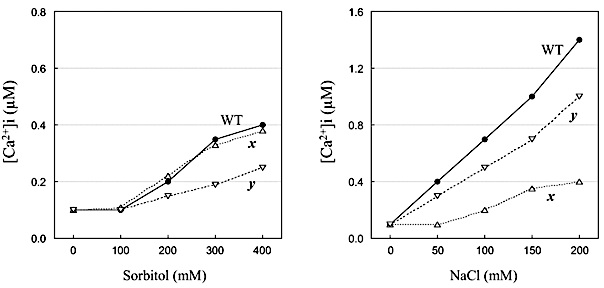 Figure 1.
Using the information and data, determine which of the statements are true or which are false.
Question reproduced from IBO 2020, Theoretical Exam 1, licensed under CC BY-NC-SA 4.0 - attributed to the International Biology Olympiad. Open the full exam PDF · Community solutions (unofficial)