Q44 - Pitx1 Expression and Convergent Pelvic Reduction in Stickleback
Three-spined stickleback Gasterosteus aculeatus are widely distributed in both marine and freshwater areas across the world. Adaptive radiation has led to morphological differences between marine and freshwater populations. Of such differences, all of the marine population have a pair of pelvic spines that evolved from the pelvic skeleton, while some freshwater populations of various localities have lost their spines (Figure 1). Genetic analyses revealed that the causative genomic region for this pelvic difference is located around the Pitx1 gene. This Pitx1 plays an important role in the development of the ventral spine, thymus, and neuromast. Although the amino acid sequences of Pitx1 transcripts are identical in both populations, the expression patterns of Pitx1 in the pelvic fin buds of embryos are different: Pitx1 is expressed in the marine population (purple), while it is not in the freshwater population (Figure 1 insets).
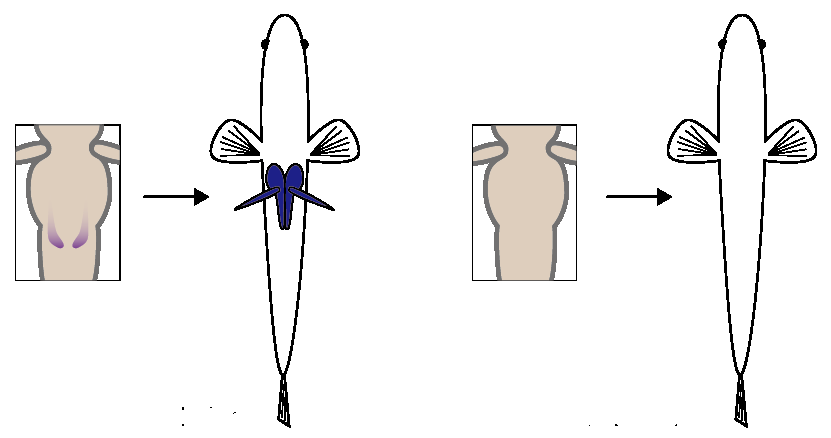 Ventral view of marine (left) and freshwater (right) sticklebacks, showing the presence/absence of pelvic spines (shown by dark blue). Anterior is to up. (Boxes) Magnified ventral view of stickleback embryos showing Pitx1 expressions in the pelvic fin buds.
Using the information and data, determine which of the statements are true or which are false.
Question reproduced from IBO 2020, Theoretical Exam 1, licensed under CC BY-NC-SA 4.0 - attributed to the International Biology Olympiad. Open the full exam PDF · Community solutions (unofficial)