Q1 - Glycogen and Amylopectin Degradation by Phosphorylase and Debranching Enzyme
Glycogen (and amylopectin) is a glucose polymer with some branching. Linear chains of these polymers consist of a(1->4) linkages and occasional branching is formed by a(1->6) linkage (Figure 1). For degradation in cells, glucose residues are released one-by-one from the end of the chains by phosphorylase up to the residue at the branching site. Then, the a(1->6) branching site is removed by a debranching enzyme.
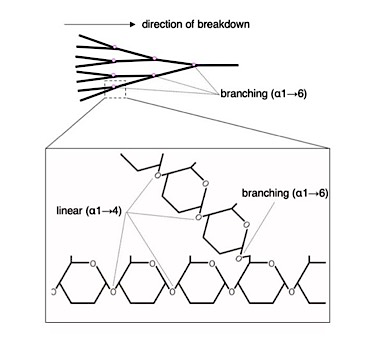 Figure 1.
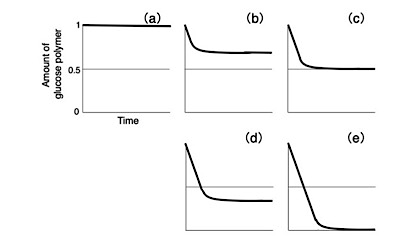 Figure 2.
Using the information and data, determine which of the statements are true or which are false.
Q1.1. Given that a certain glycogen consisting of 10000 glucose residues is branched at every 10 residues, how many terminal chains are available for phosphorylase?
Q1.2 phosphorylase. For degradation of this glycogen by excess phosphorylase (assume phosphorylase releases all glucose residues from a linear chain without branching), choose the appropriate graph for its breakdown from Figure 1's panels (a)-(e).
Q1.2 debranching enzyme. For degradation of this glycogen by excess debranching enzyme, choose the appropriate graph for its breakdown from Figure 1's panels (a)-(e).
Q1.3. Plant amylopectin is similar to glycogen but branching occurs much less frequently (every 25 residues instead of every 10, for an amylopectin of similar size to this glycogen). Indicate the combination of correct descriptions about degradation of amylopectin by phosphorylase: (a) Breakdown speed is slower than that of glycogen. (b) Breakdown speed is similar to that of glycogen. (c) Breakdown speed is faster than that of glycogen. (d) Final breakdown extent is smaller than that of glycogen. (e) Final breakdown extent is similar to that of glycogen. (f) Final breakdown extent is larger than that of glycogen.
Question reproduced from IBO 2020, Theoretical Exam 2, licensed under CC BY-NC-SA 4.0 - attributed to the International Biology Olympiad. Open the full exam PDF · Community solutions (unofficial)