Q40 - Tracing Membrane Origins in the Four-Membrane Plastids of Chlorarachniophytes
It is well-established that photosynthetic eukaryotes (algae and plants) acquired plastids through the primary symbiotic uptake of a cyanobacterium, giving plastids with two membranes. The ancestors of chlorarachniophytes, which had no plastids, acquired their plastids through secondary symbiotic uptake of a green alga; the plastids of chlorarachniophytes are bound by four membranes (Figure 1), with a remnant nucleomorph (the vestigial nucleus of the engulfed green alga) trapped between the innermost two and outer two membranes.
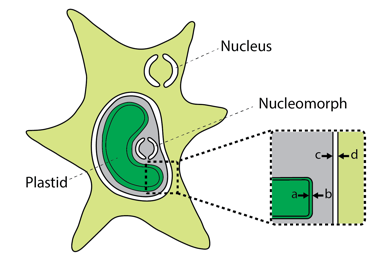 Schematic illustration of the ultrastructure of chlorarachniophytes. The box area is magnified to show that the plastid is bound by four membranes. Choose the most appropriate combination in the following.
Using the information and data, determine which of the statements are true or which are false.
Question reproduced from IBO 2020, Theoretical Exam 2, licensed under CC BY-NC-SA 4.0 - attributed to the International Biology Olympiad. Open the full exam PDF · Community solutions (unofficial)